Landscape Lighting Tips: Solar vs. Low-Voltage Wired Lights
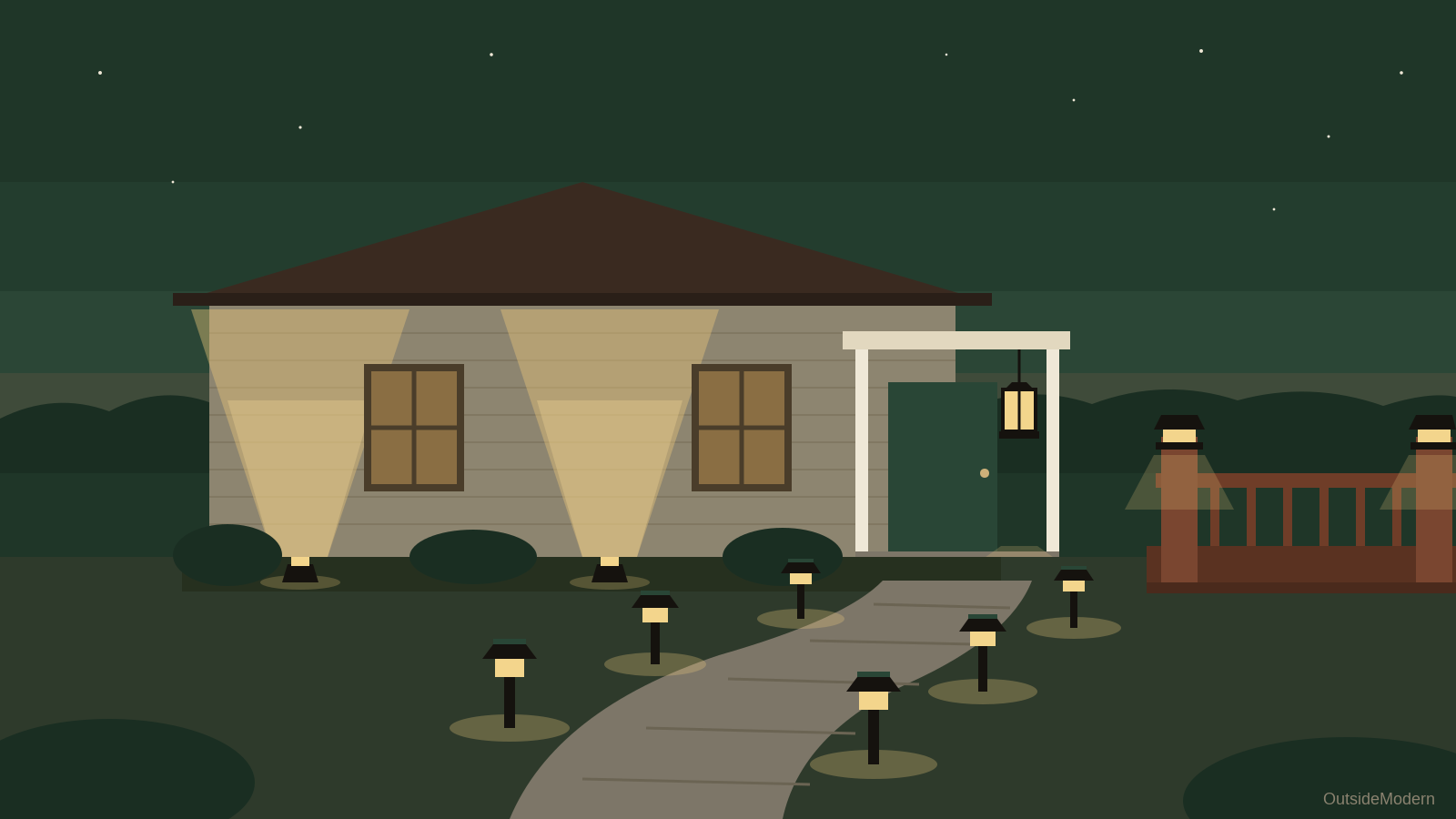
The outdoor spaces around your home are just as important as the interior, and when it comes to landscape lighting, they shouldn’t be neglected. The front of your house is the first thing people see when they arrive, and some careful, creative lighting can radically improve that impression.
The private areas and gardens are often comfortable places to sit and watch the world go by. It makes good sense to light them in a way you find attractive. These areas almost always beat sitting indoors, when the weather permits.
There are two do-it-yourself routes: solar lights, which carry their own panel and battery, and low-voltage (12 V) wired kits, which run from a plug-in transformer. Below we compare the two, walk through the yard area by area, and point you to our roundups for each type of fixture.
Solar vs. Low-Voltage Wired Lighting
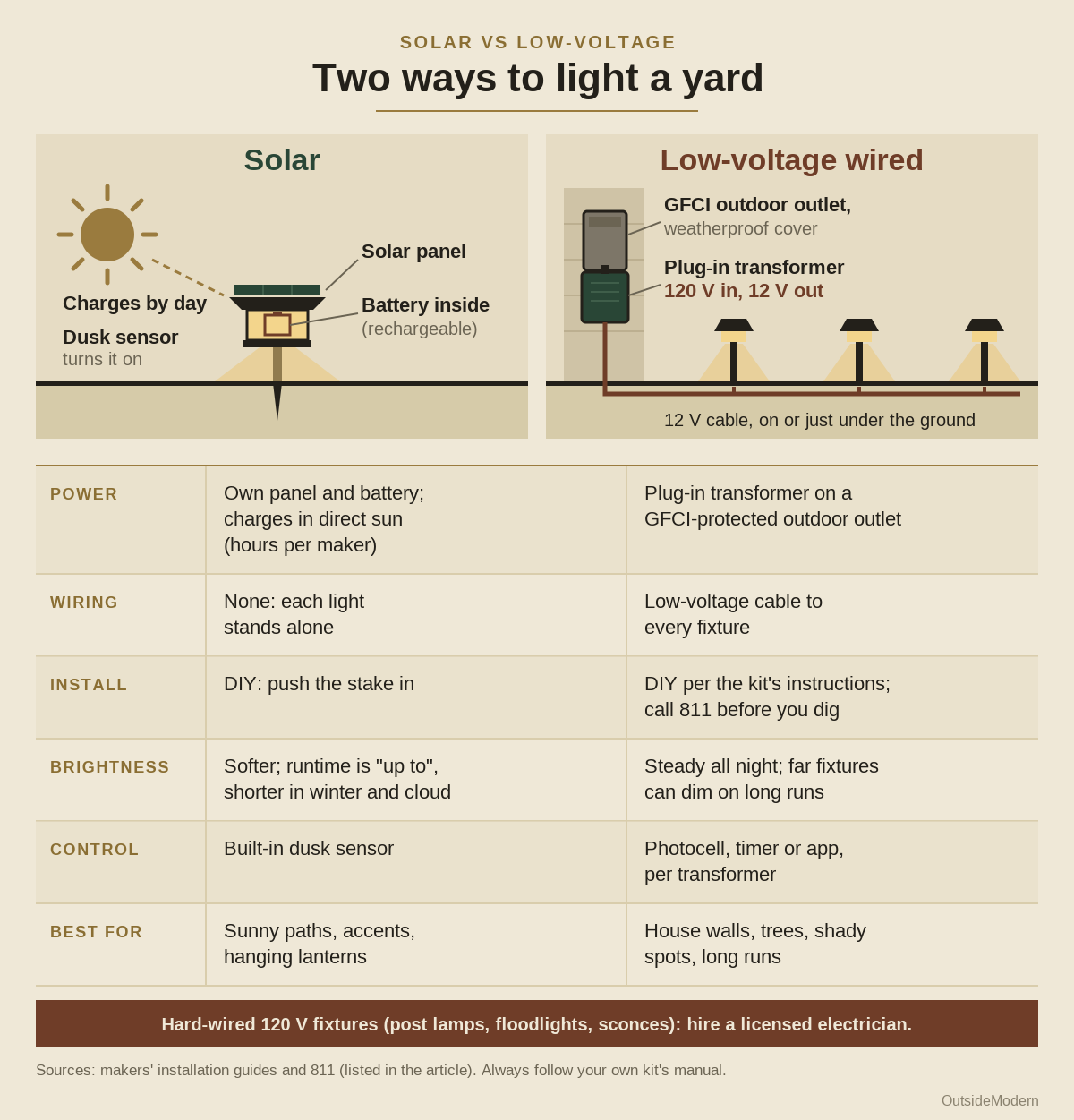
Solar lights carry their own panel and battery; low-voltage systems run 12 V fixtures from a transformer plugged into a GFCI-protected outdoor outlet.
Low-voltage landscape lighting runs 12 V fixtures from a transformer that plugs into a GFCI-protected outdoor outlet and steps household 120 V down. The cable runs on or just under the ground, so most homeowners can install a kit by following the maker’s instructions.
Solar lights skip the cable altogether. Each one charges by day and switches on at dusk, which makes them the easiest lights to add, as long as the spot gets enough direct sun.
| Solar | Low-voltage (12 V) wired | |
|---|---|---|
| Power | Panel and rechargeable battery in each light | Plug-in transformer on a GFCI-protected outdoor outlet |
| Wiring | None | Low-voltage cable from the transformer to each fixture |
| Install | Stake it, hang it or screw it on | DIY per the kit’s instructions; call 811 before you dig |
| Brightness | Softer, and can fade through the night | Steady all night; far fixtures can dim on long runs |
| Control | Built-in dusk sensor | Photocell, timer or app, depending on the transformer |
| Best for | Sunny paths, accents, decks and hanging lanterns | House walls, trees, shady spots and long runs |
Our advice is to mix them. Use solar where the sun is good and the job is marking a path or adding a glow, and use low-voltage where you want steady, brighter light. Hard-wired 120 V fixtures are a different matter: those are a job for a licensed electrician (more on that below).
Landscape Lighting Tips by Area
To light the outside of your home well, it’s best to break the space down by what each area is for. Once you’ve identified the major areas, you can choose the right lighting for each one. Here are the common ones.
Front Yard
The front yard connects the street to the house. Depending on the lot, it can be a few feet deep or hundreds of feet deep. Lighting here can accentuate the plantings and guide anyone walking from the street or driveway to the front door. Path lights and a couple of up-lights on a tree or the house wall usually do the job.
Front Porch
The front porch has a dual purpose: shelter for those waiting to enter the house, and a neighborly spot where you can sit, enjoy the evening and still be part of the community. A solar hanging lantern adds a glow here if the porch gets direct sun.
Balcony
If you have a balcony, whether it faces the front or the back, it’s usually more private than a front porch. Lighting there should be more ambient, since you don’t need to guide visitors into an unfamiliar house. Outdoor string lights or a lantern on the rail work well.
Back Yard/Garden
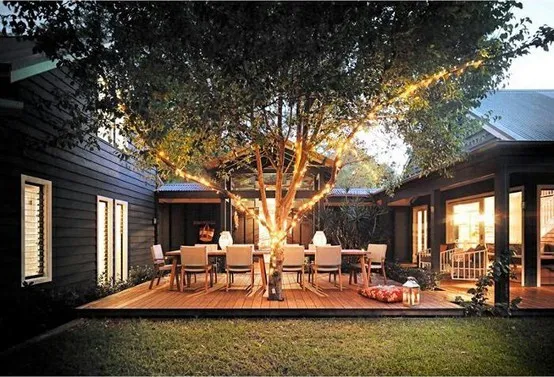
Backyard lighting can be daunting, as there are many aspects to consider. Brighter light helps kids play later in the evening, ambient lighting sets the mood, and task lighting helps if you’re composting or gardening after work. For more ideas, see our DIY garden lighting ideas and our roundup of the best solar lights for gardens.
Deck/Patio
Decks and patios generally need a mix of task and ambient lighting. The grill or outdoor kitchen often lives here, so task lighting matters if there’s going to be cooking going on.
The deck or patio is also often the main sitting area outside, so you’ll want ambient light for eating, reading and conversation. A pergola is a ready-made frame for string lights.
Finally, people walk around these spaces a lot, so mark the steps and edges. Our guides to solar deck lights and solar post cap lights cover both.
Walkways
Walkways are critical spaces for safety lighting. You want enough light for people to navigate safely, take out the trash and deliver boxes, without turning the path into an airport runway. Solar path lights are the usual answer; see our page on Westinghouse solar path lights, which covers the brand’s current solar bollard sets and the kits it used to sell.
Fixture Types (and Where to Find Our Picks)
Each fixture type has a job. Here’s what each one is for, with one example from the maker where we have one, and the roundup that covers it in depth.
Path Lights
Path lights are short stake lights that throw pools of light onto a walk or bed edge. Space them so their pools of light just meet, using the spacing the maker gives for that fixture, and stagger them on both sides rather than lining them up like a runway.
Example: the Gama Sonic Contemporary Square Solar Path Light is rated at 80 lumens, with a warm white (2700K) or bright white switch and a replaceable 1500 mAh lithium-ion battery, though Gama Sonic says it’s sold through “a limited distribution channel”. More path lights are in our solar garden lights roundup.
Spotlights and Up-lights
Spotlights aim a narrow beam at one feature: a tree, a shrub or the house wall. They’re the main tool for up-lighting (see placement, below).
Example: the Gama Sonic Tri-Color Progressive Solar Spotlight is rated at 100 lumens, has three colour settings starting at warm white (3000K), and has a detachable panel that can sit up to 20 ft away in the sun, which helps in a shady bed. It’s covered in our solar garden lights roundup too.
Deck, Step and Rail Lights
Small solar lights screwed to deck walls, stair stringers and rails mark each edge and tread without running a wire. They’re markers, not floodlights.
Example: the Classy Caps SL178 Black Aluminum Deck & Wall Light is a 12-lumen light that stays lit for up to 12 hours, per Classy Caps, on a replaceable AA Ni-MH battery; it’s sold singly with a one-year limited warranty. Our solar deck lights guide has more.
Post Cap Lights
Solar post caps sit on top of deck and fence posts, which puts the panel right where the sun reaches. The catch is fit: caps are sized for wood 4x4s, vinyl sleeves and 6x6 posts, so measure first. Our post cap guide explains the sizes.
Hanging Lanterns
Solar hanging lanterns provide accents and a great deal of style, depending on the design. Hang them from a branch, a porch beam or a shepherd’s hook, anywhere the panel still gets direct sun.
Example: the BioLite Luci Original Clear is an inflatable solar lantern rated at up to 75 lumens, with an IP67 rating and a 1,000 mAh lithium-ion battery, per BioLite, and a one-year warranty. It’s more usable light than décor, and it’s in our solar hanging lanterns roundup.
Decorative Solar Lights
If you’re after decorative solar lighting, you’ll find designs from birds and butterflies to flowers and glowing balls. Trendscape, which no longer sells its solar lights, was a well-known name here; our Trendscape page keeps the history and points to current options. Treat decorative lights as accent pieces: a soft glow in a bed, not path lighting.
String Lights
String lights are almost certainly the most versatile outdoor lights. Plug-in strings need no electrician, and solar strings need no outlet at all. They can be bunched up, wrapped around trees or strung along porch ceilings. Our outdoor string lights roundup, linked above, covers both kinds.
Solar Landscape Lighting: How It Works
Solar lights charge during the day, turn on automatically at dusk and run until dawn or until the battery runs low, whichever comes first. They can go almost anywhere and install without professional help.
The catch is sun. Gama Sonic’s guidance is about 4–6 hours of direct sun, and some other makers ask for more, so check your light’s manual. A spot that doesn’t get much direct sun will struggle. Keep the panel away from other lights at night too, since they can trick the dusk sensor.
Makers quote runtime as “up to” a number of hours after a full charge. Expect less on short winter days, in cold weather and after cloudy spells. Solar lights are also softer than wired ones and can gradually dim over the course of the night.
Upkeep is simple. If a light that used to run all night now fades early, replace the rechargeable battery with the type and size the maker specifies, and wipe the panel with a damp cloth (no cleaners).
Low-Voltage (12 V) Wired Lighting
A low-voltage kit has three parts: a transformer (Intermatic calls it a power pack), low-voltage cable, and the fixtures. The transformer plugs into an outdoor outlet and steps household 120 V down to 12 V. Line voltage is “120v, the same voltage found in a typical wall outlet,” as Fine Homebuilding puts it, and low voltage is, in its words, “safer and more flexible for homeowners to adjust and maintain.”
That’s why 12 V kits are a DIY job. Volt Lighting, which makes them, says you “do not need to be a licensed electrician to work with them.” Follow the kit maker’s instructions, and keep these points in mind:
- Plug into a GFCI outlet. Intermatic’s instructions say to “plug into a GFCI outdoor electrical outlet protected by a weatherproof receptacle cover,” and not to use an extension cord.
- Don’t overload the transformer. Add up the wattage (or VA) of every fixture; the total must not exceed the transformer’s rating, per Kichler and Intermatic. Leave room if you plan to add lights later.
- Watch long runs. Lights at the far end can look dimmer because of voltage drop. Follow your kit’s cable-gauge chart, and use heavier cable or split into more runs if the maker says to.
- Check the kit’s burial depth. Bury or cover the cable only as deep as your kit’s instructions say (often a few inches).
- Call 811 first. Before any digging project, even planting, call 811 or make an online request so utilities can mark buried lines. It’s a free service. Wait times vary by state, and once the marks are down, keep power tools out of the 18–24 in zone around them; hand-dig there or ask your 811 centre.
LEDs also make a low-voltage system cheaper to run: the US Department of Energy says LEDs use about 75% less energy than incandescent bulbs and last many times longer.
Line-Voltage (120 V) Fixtures
Hard-wired 120 V fixtures, such as post lamps, floodlights and wall sconces, are a job for a licensed electrician working to local code. Volt Lighting notes that line voltage “requires an electrician for installation.” Check with your local building or electrical department about permits, since the rules vary.
If you’re renovating or building new, it can make sense to have the electrician who’s already on site run conduit for any wired lighting while the ground is torn up anyway.
Wired Lighting Safety Tips
- Hire a licensed electrician for anything 120 V.
- Buy fixtures and transformers from reputable dealers, rated for outdoor use.
- Check fittings, cables and connections every few months.
- If lights flicker or there’s an obvious fault, unplug the transformer or turn the power off.
- Keep cables and the transformer tidy and out of the way of mowers and edgers.
Placement and Aiming
When lighting the front of a home, there are two choices for ambient lighting: downlighting and uplighting. Downlighting is often placed in the soffit and shines down from above, while uplighting sits on the ground around the house and shines upward.
Soffit Lighting
Soffit lighting sounds good in theory but often results in a less-than-ideal look.
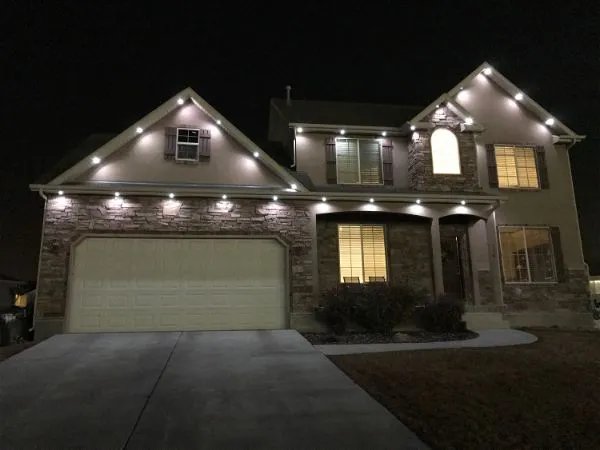
Soffit lights often produce a Christmas-light effect, with uneven blips of light and shadow and a look that lacks cohesion. That’s largely because you can see the lights themselves as you look up at them.
Instead, it’s usually best to shine your lights up from the ground and wash those lights over the walls. The lights can be concealed in trees or bushes.
Uplighting
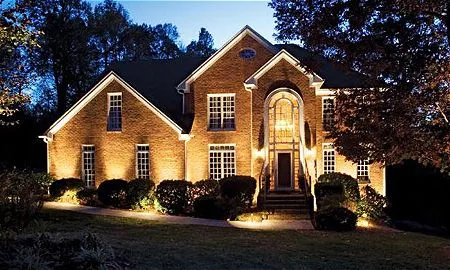
Uplighting tends to look much better. The lights sit a short distance from the house and shine up at an angle against the walls and front-facing gables. It’s attractive and quite simple to set up. Light flowerbeds and trees the same way, so you can see them glowing through your windows.
Glare and Light Pollution
The one downside of uplighting (sorry, couldn’t resist!) is light pollution. Following DarkSky International’s lighting principles, choose shielded fixtures aimed down, warm-white bulbs, and a timer or motion sensor.
A few more tips:
- Don’t aim lights at your windows or a neighbor’s. Tuck lamps behind shrubs, use walls and rocks to cut the angle, or fit glare guards on bright fixtures.
- Keep light out of the eyes of anyone sitting on the patio. Shadows help create a pleasant evening glow.
- Fine-tune the position of your lights after dark, as everything looks different than it does during the day.
- Many people prefer white light in the garden, as with moonlight, though colored lights have their place.
Water Features
If you have a pond or other water feature in your yard, lighting it at night creates a soothing mood and marks it for safety. Use only lights the maker sells for underwater use, and plug the transformer into a GFCI-protected outdoor outlet, as with any low-voltage system. A few aiming tips:
- For a pond, skim the light across the surface to create a glimmering effect.
- For cascading water, aim the light where the water lands, not at the flowing water.
- If you have fish, leave an area dark for them, even if it’s only under pond plants or furniture.
- Light-colored stones in the water will highlight the glow, while darker ones dim it.
- Water bends light, so experiment with the position of your lamps.
Security Lights
Put motion-sensor lights in the areas you want lit for security. That way they only turn on when needed.
Timers, Sensors, and Automation
Solar lights generally turn on automatically at dusk and run until dawn or until the battery runs low. Low-voltage and line-voltage lighting give you more control: switches, dusk-to-dawn sensors, timers, motion sensors and apps.
Standard Switches
Wired lighting can be run from an ordinary switch that turns everything on and off.
Dusk to Dawn Lighting
Dusk-to-dawn lighting uses a photocell to switch a lamp on when it gets dark and off at dawn. It’s ideal for walkways and front yards, where you don’t want to think about switching lights every time you need them. Many low-voltage transformers have a photocell and timer built in.
However, if you don’t want the lights on all night, use the timer to switch them off at a set hour.
Motion Sensors
Motion lighting is great for safety and driveway lighting. These lights turn on when they sense movement. They can be super helpful, but if there are lots of wild or domestic animals around, or passers-by can trigger them, they get annoying. No one wants a light flicking on and off every 10 minutes at night!
Automation
App control is now common. Some transformer makers sell an add-on timer for it; Kichler’s Smart Control Timer, for example, “works with the Kichler Connects app so you can digitally control your landscape lights.” For plug-in lights, a smart plug rated for outdoor use does a similar job.
Flame and Fire
Tiki torches, fire pits, chimineas and oil lanterns add warmth and flicker that electric lights can’t match, but they’re real flames, so keep an eye on kids, pets and nearby plants. Our guides cover metal tiki torches, tiki torch fuel, citronella oil lanterns, copper fire pits, and clay, modern and classic chimineas.
Frequently Asked Questions
Is solar or low-voltage landscape lighting better?
Neither wins everywhere. Solar is easiest to install and needs no cable, but it depends on direct sun and gives softer light that can fade through the night. Low-voltage wired lighting is steadier and brighter and works in shade, but you’ll need an outdoor GFCI outlet and some cable. Most yards look best with a mix.
Can I install low-voltage landscape lighting myself?
Yes, for 12 V kits, if you follow the maker’s instructions; Volt Lighting says you don’t need to be a licensed electrician to work with them. Plug the transformer into a GFCI-protected outdoor outlet, keep the fixture load within its rating, and call 811 before you dig. Hard-wired 120 V fixtures are a job for a licensed electrician.
How much sun do solar landscape lights need?
Gama Sonic’s guidance is about 4–6 hours of direct sun, but some other makers ask for more, so check your light’s manual. Expect shorter runtimes in winter and after cloudy days.
Do I need to call 811 before installing landscape lights?
Call before any digging project, even planting, so utilities can mark buried lines. 811 is a free service, and wait times vary by state. Keep power tools out of the 18–24 in zone around the marks and hand-dig there.
What colour temperature is best for landscape lighting?
Warm white, around 2700–3000 K, is the usual choice for landscape lighting, according to Volt Lighting. For darker skies, UF/IFAS Extension suggests warm-white bulbs under 3600 K.
Why are my solar lights dim or not turning on?
Gama Sonic lists five usual causes: not enough direct sun, another light nearby fooling the sensor, a battery that needs charging or replacing, a dirty panel, and water inside the lamp head. Also check the on/off switch, and give new or stored lights a full day or more of sun before judging them.
Conclusion
Lighting your exterior can be a fun, creative and rewarding project, and it can add real curb appeal to your home.
A creative mix of lighting does the most for your outdoor spaces. Use solar for paths, accents, decks and hanging lanterns where the sun is good, low-voltage wired lighting where you want steady, brighter light on walls and trees, and a licensed electrician for anything 120 V. Then add flame or string lights for atmosphere.
We hope this gives you some good ideas, and we wish you the best in designing the perfect lighting for your outdoor space!
Previously recommended
- InnoGear solar spotlights, Kanstar solar lamp post and Ankway solar fairy lights: dropped from this page; we now point to the roundups above.
- The wired post lamp, sconce, floodlight, string light, torch, oil lantern and fire pit picks have moved to their own guides, linked above.