Best Pond Vacuum: Clear Muck Without Draining Your Pond
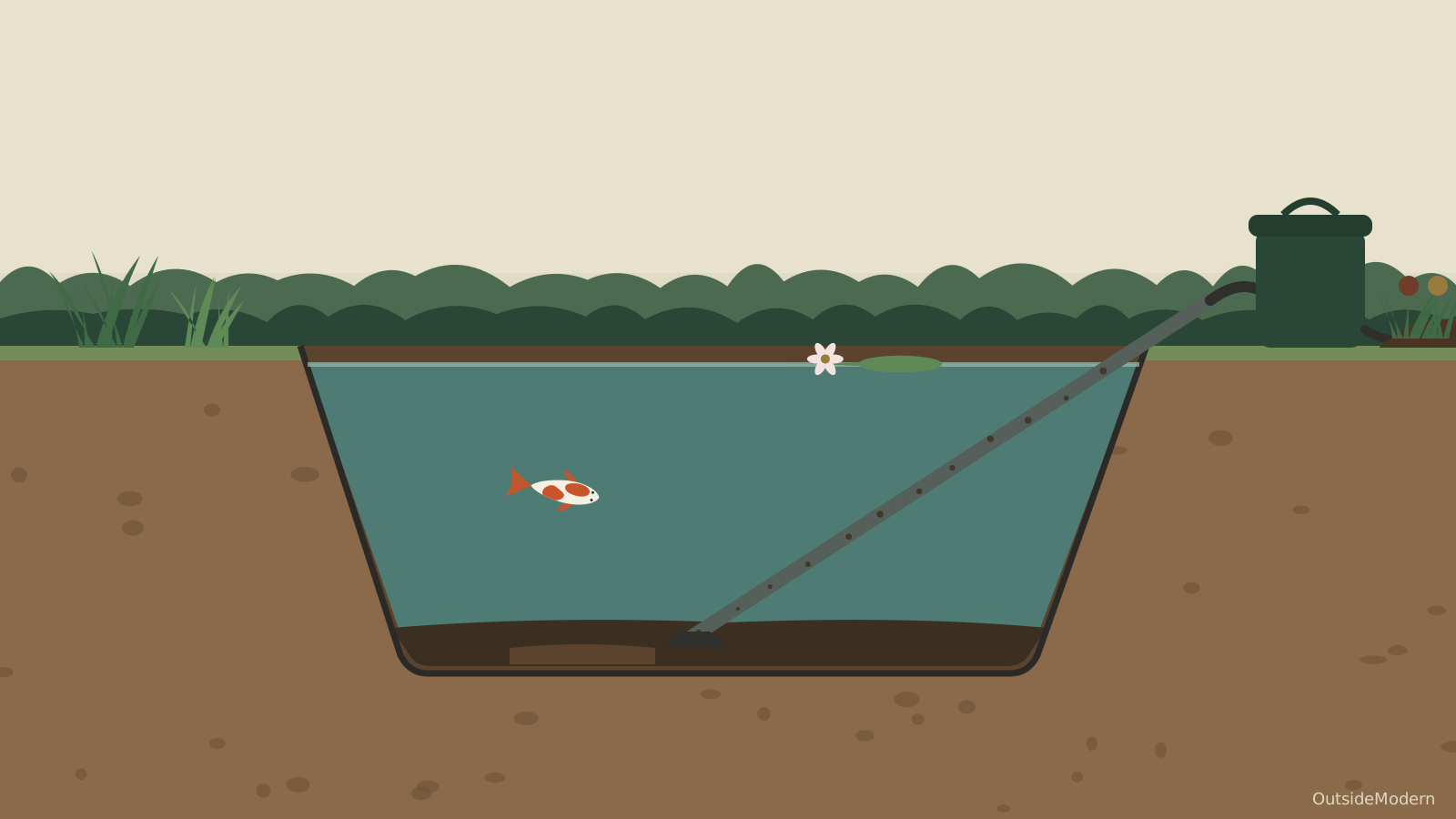
A pond can make a landscape look stunning and feel peaceful at the same time. The catch is the muck: leaves, dead algae and fish waste settle on the bottom, and over a season they turn clear water the color of tea. A pond vacuum pulls that layer out without draining the pond or wading in with a net.
The best pond vacuum for you depends mostly on the design, and there are four of them: fill-and-drain, two-chamber, continuous pump and hose-powered. We picked one of each, and we explain how each design works and where the dirty water should go. For the pump, filter and UV side of keeping a pond clear, see our pond pump and filter guide.
What’s changed in this update: our old top pick, runner-up and the Blagdon Monsta are no longer available from the listings we linked. We rebuilt the list around the four designs, took every spec from the makers’ manuals and pages, and checked each electric vac for a safety listing. We also added sections on when to vacuum and how to clear muck without one.
Hose-Powered Vac With Nothing to Plug In
Our budget pick is the Python Ulti-Vac Pond Maintenance System. It runs on garden-hose water pressure instead of electricity, traps larger debris in a removable waste chamber, and comes with a 4 ft cleaning tube and a 13 ft discharge hose. It’s best for small ponds, corners and spot cleaning.
For larger ponds we cover three electric vacs below: OASE’s continuous-pump PondoVac 5, OASE’s fill-and-drain PondoVac Classic, and The Pond Guy’s two-chamber ClearVac. Intertek’s ETL directory lists all three to the UL vacuum-cleaner standard.
Pond Vacuums at a Glance
Specs are from each maker’s manual or product page. A blank means the maker doesn’t state it.
| Pick | Design | Suction depth | Suction / discharge hose | Cord | Notes |
|---|---|---|---|---|---|
| OASE PondoVac 5 | Continuous discharge pump | up to 7.5 ft | not stated / up to 65 ft long | 25 ft | Vacuum head up to 1,900 GPH; 53.6 lb |
| The Pond Guy ClearVac | Two-chamber | 6 ft | 16 ft / 8 ft | 13 ft | 1,600 W; 3-year warranty |
| OASE PondoVac Classic | Fill-and-drain | 13.2 ft / 6.6 ft | 13.2 ft | Pauses about 25 seconds to drain | |
| Python Ulti-Vac | Hose-powered | 4 ft cleaning tube / 13 ft | none | No electricity |
Pond Vacuums – What To Look For
A pond vacuum works like a wet vac with a long wand: it pulls water and muck up a hose into a chamber, catches the debris, and sends the water out a discharge hose. What separates one from another is how it gets rid of that water, how far it reaches and how it’s powered.
How Pond Vacuums Work: Four Designs
A pond vacuum pulls water and settled muck up a wand into a collection chamber, where a bag or the chamber traps the debris and the water leaves through a discharge hose. Designs differ in how they empty that chamber:
- Fill-and-drain (single chamber): the vac sucks until the tank is full, a float switch stops the motor, the tank drains by gravity through the discharge hose, and suction restarts on its own. OASE says its PondoVac Classic restarts after 25 seconds.
- Two-chamber: one chamber fills while the other drains, so suction keeps going. The Pond Guy’s ClearVac switches reservoirs automatically.
- Continuous pump: a built-in discharge pump empties the tank as it fills, so there’s no pause, and the pump can push the water some distance away. The OASE PondoVac 5 works this way.
- Hose-powered: no motor at all. Garden-hose water pressure drives the suction, as on the Python Ulti-Vac, so it’s slower but there’s nothing to plug in.
Pond Vac vs Wet/Dry Vac
Can you just use a shop vac? A shop vac fills fast and has to be emptied by hand, over and over. A pond vac drains itself, carries a longer wand and comes with nozzles for sludge, string algae and gravel.
Hose Length and Reach
Look at both hoses. The suction hose and extension tubes decide how far into the pond you can reach, and the discharge hose decides where the dirty water ends up. The makers’ figures vary a lot: the PondoVac Classic has a 13.2 ft suction hose and a 6.6 ft drain hose, the ClearVac has a 16 ft suction hose and an 8 ft discharge hose, and the Python has a 4 ft cleaning tube on a 13 ft discharge hose.
Depth matters too. OASE rates the PondoVac 5’s suction hose for up to 7.5 ft and says suction drops off below about 6.6 ft (2 m). The Pond Guy’s manual gives the ClearVac a 6 ft maximum operating depth.
Electric Cord, Outlet and Safety Listing
This is where we’re strict. Plug a pond vacuum only into a GFCI-protected outdoor outlet, or a portable GFCI if your outlet isn’t protected. The CPSC says GFCIs “protect against electrocution” and recommends them specifically for corded tools used around ponds. If you don’t have a protected outlet near the pond, have an electrician add one.
Follow your vac’s manual on extension cords rather than any general rule. The Pond Guy, for example, allows “only a 10 or 12 gauge outdoor rated extension cord no longer than 50 feet” for the ClearVac, while OASE’s PondoVac 5 manual says extension cables must be “suitable for outdoor use (splash-proof).” Don’t cut, splice or repair the cord yourself. The Pond Guy says cord alterations void the ClearVac’s warranty, OASE’s manuals rule out modifications to the unit, and the CPSC’s advice is to have a damaged cord replaced by a qualified repair facility.
Keep the motor unit on firm, level, dry ground, never in the water. OASE’s manuals for the PondoVac 5 and Classic say to set the unit at least 6.6 ft from the pond and not to run it in the rain. If a vac does fall in, unplug it at the outlet before you reach for it.
We also look for a safety listing. Every electric vac we recommend appears in Intertek’s ETL Listed Mark directory, listed to UL 1017, the standard for electric vacuum cleaners, and its Canadian counterpart.
Powered Discharge or Gravity Drain
Some vacuums use a powered discharge pump, while others let the water drain out by gravity. A powered discharge can send water uphill or farther away, which helps when the nearest flower bed is across the yard. OASE’s PondoVac 5 manual allows a discharge hose up to 65 ft long and up to 6.6 ft higher than the unit.
Gravity-drain vacs are simpler, but the discharge hose has to run downhill. The Classic’s manual says to lay the drain hose low so the tank empties during each pause.
Suction Power and Pond Size
For a big pond, a continuous design saves the most time because it never stops to drain. OASE rates the PondoVac 5’s vacuum head at up to 1,900 GPH. The Pond Guy doesn’t publish a flow figure for the ClearVac, and the PondoVac Classic’s manual doesn’t list one either; an OASE dealer lists the Classic at up to 800 GPH.
For a small pond or a container water garden, a fill-and-drain or hose-powered vac is plenty. You’ll wait through the drain pauses, but you won’t be at it for hours.
Fish in the Pond
None of the manuals we read gives a fish-specific instruction. Keep the nozzle on the bottom and away from fish, and work slowly. Check the collection chamber or bag for small fish and fry before you empty it.
A pond is also a drowning hazard for small children. The American Academy of Pediatrics notes that young children can drown in an inch or two of water and advises fencing or securing backyard ponds and fountains. Never leave the pond unattended while it’s partly drained or the vacuum is running, and check your local rules on barriers.
Clogging and Nozzles
Pond vacs clog when the nozzle opening is too small for what’s on the bottom, or when you plunge it into a thick pile of leaves. Pick a vac whose nozzle set matches your pond. The PondoVac Classic’s bottom nozzle opens to 0.4 in for thick sludge on a liner and closes to 0.1 in over gravel, and The Pond Guy says the ClearVac picks up debris up to 3/8 inch across.
Big leaves are better scooped with a net first, or caught before they sink by a pond skimmer.
What To Do With the Water
Pond vacuums send dirty water out the discharge hose, and you get to choose where it goes.
Back to the Pond
Some vacs let you return the water through a fine filter bag. OASE allows that on the PondoVac 5 only when it’s catching coarse particles, and says “do not allow muddy water to flow back into the pond.” The Pond Guy doesn’t recommend returning ClearVac water to the pond at all, because it can cloud the water. The nutrients in that water also feed algae, so returning it gives back some of what you just removed.
Out to the Garden
Many pond keepers run the discharge hose onto flower beds or a lawn, where the nutrient-rich water soaks in instead of feeding the next algae bloom. Skip the beds if you’ve salted the pond (UC IPM notes sodium at the roots stunts plants) or recently used a treatment whose label says otherwise.
Never send the water down a storm drain. The EPA notes that storm drains carry water to streams and lakes with no treatment. And never dump fish, plants or vacuum water into a creek or lake: the U.S. Fish and Wildlife Service asks pond keepers to bag and trash unwanted plants rather than release them.
When to Vacuum (and When Not To)
K-State Research and Extension’s maintenance calendar has you dredge winter debris off the bottom in spring and again as needed through summer, and put up leaf netting in fall so less muck builds up. It lists a full or partial pond cleaning in winter. Texas A&M’s EarthKind guide adds that spring algae blooms tend to come as the water warms while plants are still dormant, which is one reason a spring clean-out helps.
Why bother? Muck is mostly rotting leaves, dead algae and fish waste. As it breaks down it uses oxygen, gives off ammonia (NMSU Extension calls it “the first form of nitrogen released when organic matter decays”) and returns nutrients that feed algae.
Vacuuming lets you pull muck without draining. Texas A&M’s EarthKind guide warns that changing the water only delays the pond’s natural balance, and K-State says never to power-wash the liner, because the film on it is home to beneficial microorganisms. So vacuum the loose muck and leave the coating on your pond liner alone.
Work slowly and keep the nozzle on the muck rather than stirring it up. UF/IFAS Extension notes that stirring up bottom sediment can use up oxygen in the water above it, which is hard on fish.
If you top the pond up from a city tap, use a pond-labeled dechlorinator that also handles chloramine. UF/IFAS Extension calls chloramine “very toxic to fish,” and it doesn’t air out the way plain chlorine does. For water testing and seasonal fish care, see our koi pond care guide.
Muck Removal Without a Vacuum
You don’t need a vacuum for every job. K-State suggests a fine net on a long handle for bottom debris, and leaf netting or skimming in fall to keep muck from building up. UF/IFAS Extension says rakes, shovels and hand dredges work on small areas. Whatever you use, plan to repeat it.
Bacteria products sold to “digest” sludge are a supplement, not a substitute. K-State’s calendar suggests adding beneficial bacteria in spring, but UF/IFAS Extension finds little scientific evidence that they remove muck, partly because oxygen can’t reach deep sediment. Follow the product label on water temperature.
Muck-choked, still corners can also breed mosquitoes. UC Integrated Pest Management advises keeping water circulating and removing the organic debris larvae feed on. For still water you can’t keep moving, a Bti larvicide used per its label targets mosquito larvae; more in our mosquito control guide.
A small waterfall is one way to keep the water moving.
Pond Vacuum Reviews
Here’s a closer look at each pick, in order from the biggest ponds to the smallest jobs.
1. OASE PondoVac 5
The PondoVac 5 is OASE’s continuous pond vacuum. A suction head fills the tank while a separate discharge pump pumps the dirty water out the whole time, so there’s no stop to drain. OASE rates the vacuum head at up to 1,900 GPH, which makes it the pick for large garden and koi ponds.
The discharge pump is the big advantage. OASE’s manual allows a discharge hose up to 65 ft long and up to 6.6 ft higher than the unit, so you can send the water to a bed across the yard. It comes with surface, wet, algae, universal and brush nozzles, two extension tubes (one clear), a debris bag and a fine filter bag.
Read the manual before the first job. OASE says to set the unit at least 6.6 ft from the pond on firm, level ground, to use a fault-current protection device rated for 30 mA, and to connect it only to a grounded outlet. It also warns that if the unit sits below the water line, the pond can siphon out through the tank, so always take the suction hose out of the pond when you switch the vac off. And OASE’s own manual says “The Pondovac5 is not an outdoor product. It is only used from time to time outdoors,” so store it indoors between jobs.
The drawbacks are weight and fuss. At 53.6 lb it’s heavy to carry to the pond, and OASE excludes the foam filter, debris bag, seals, wheels, non-return valve and impeller unit from its warranty as wear parts.
Intertek’s ETL directory lists the PondoVac 5 (model 48080) under OASE’s factory, to UL 1017 and its Canadian counterpart.
Read OASE’s PondoVac 5 operating manual (PDF) before you buy.
OASE PondoVac 5
Continuous pond vacuum with a separate discharge pump, ETL listed to UL 1017.
2. The Pond Guy ClearVac
The ClearVac is a two-chamber vac sold by The Pond Guy. When one reservoir fills, it switches and drains, so you keep vacuuming. It comes with four black and one clear extension tube, and string-algae, narrow, wide and adjustable gravel nozzles. The Pond Guy says it picks up debris up to 3/8 inch across.
Its manual has some of the clearest electrical rules here: plug it into a grounded, GFCI-protected outlet, use a drip loop, and if you need an extension cord, use “only a 10 or 12 gauge outdoor rated extension cord no longer than 50 feet.” Keep it near the edge at about water level for the best suction, but never where it could fall in. If it does, unplug it before you reach for it.
The drawbacks: the 8 ft discharge hose is short, so you’ll need a bed or lawn close to the pond, and the maker doesn’t recommend returning the water to the pond. Its product page gives a 7 ft depth while the manual says 6 ft; we go with the manual. The manual’s parts list also marks the collection chamber spare as discontinued.
Intertek’s ETL directory lists the ClearVac (model 160192) under The Pond Guy, to UL 1017 and its Canadian counterpart. Its 3-year limited warranty is the only warranty term any maker here states.
The Pond Guy ClearVac Dual-Chamber Pond Vacuum
A dual-chamber pond vacuum from The Pond Guy that switches reservoirs as one fills, so suction keeps going while the other drains.
What we like
- Two chambers keep suction going while one drains
- Clear GFCI and extension-cord rules in the manual
- 3-year limited warranty
- Four nozzles, including an adjustable gravel nozzle
Worth noting
- Short 8 ft discharge hose
- Maker doesn't recommend returning the water to the pond
- Collection chamber spare is listed as discontinued
3. OASE PondoVac Classic
The PondoVac Classic is OASE’s simplest pond vac. It sucks until a float switch stops it when the container is full, the sludge water drains out through the drain hose, and suction restarts on its own after 25 seconds. It’s a good fit for small ponds and occasional clean-ups.
The bottom nozzle adjusts: open to 0.4 in for thick sludge on a liner, or closed to 0.1 in over gravel. With the paper filter bag, it doubles as a dry vac. OASE doesn’t print a flow figure in the manual; a dealer lists it at up to 800 GPH.
OASE says to place the unit at about water level and at least 6.6 ft from the pond, to plug it only into a grounded 120 V outlet with no adaptor, and to store it indoors out of the rain. The manual doesn’t mention GFCI protection, so follow the CPSC’s general advice and use a GFCI-protected outlet anyway.
The drawbacks: the 25-second pause every time the tank fills slows a big job, and the 6.6 ft drain hose doesn’t reach far. The manual gives no extension-cord guidance, and foam filters, valve rubber parts and filter bags aren’t covered by the warranty.
Intertek’s ETL directory lists the PondoVac Classic (model 57347) under OASE’s factory, to UL 1017 and its Canadian counterpart.
Read OASE’s PondoVac Classic operating manual (PDF) before you buy.
OASE PondoVac Classic
Fill-and-drain pond vacuum for small ponds, ETL listed to UL 1017.
Hose-Powered Vac With Nothing to Plug In
4. Python Ulti-Vac Pond Maintenance System
The Python Ulti-Vac is a simple vacuum, which makes it ideal for anyone who wants something easy to use on a small pond. Unlike the other vacs on our list, it isn’t electric. It hooks up to your garden hose and runs on water pressure, so there’s no cord near the water.
Python says it pulls rotting debris from pond bottoms, corners and dead spots, and that larger organic matter is trapped in the removable waste chamber, which you can empty onto the garden. The kit includes the 13 ft discharge hose with its connector and pump, a filter tube and cap, a body tube with collar and a 4 ft cleaning tube.
It does vacuum, but slowly. Python describes a “low flow rate and dual ergonomic handles” for controlled cleaning, which is fine for spot work and slow going on a big pond. The 4 ft cleaning tube also limits how far you can reach from the edge.
Python doesn’t say whether any tap water ends up in the pond. If it does, or if you top up from the tap afterward, treat it with a pond-labeled dechlorinator that handles chloramine.

Python Ulti-Vac Pond Aquarium Maintenance System
Simplifies routine pond maintenance
What we like
- No electricity, so no cord near the water
- Reaches corners and dead spots
- Removable waste chamber catches larger debris
- Simple kit that connects to a garden hose
Worth noting
- Slow on a big pond
- Short 4 ft cleaning tube
- Needs a garden-hose tap nearby
- Python states no warranty terms
Also Consider
OASE PondoVac 4. This two-chamber vac is OASE’s best-known model, and OASE dealers still sell it. But we couldn’t find a UL, ETL or CSA listing for it in OASE’s documents or in Intertek’s directory, so we can’t recommend it until we can confirm one. The PondoVac 5 or the ClearVac covers the same job.
Matala Pond Vac II. A single-chamber vac that shuts off when full, drains for 25 seconds and restarts, much like the PondoVac Classic. Its manual calls for a GFCI outlet and at least 6.5 ft of clearance from the pond, but it states no safety listing, so it stays a mention.
Previously Recommended
- PondLeader 1400 W Pond Vacuum — no longer available from the listing we linked; we now recommend the OASE PondoVac Classic instead.
- Matala Power Cyclone — no longer available from the listing we linked; we now recommend the OASE PondoVac 5 instead.
- Blagdon Monsta Pond Vacuum — no longer available from the listing we linked; we now recommend the OASE PondoVac Classic instead.
Frequently Asked Questions
How does a pond vacuum work?
A motor, or garden-hose water pressure on a model like the Python, pulls water and muck up a wand into a chamber. A bag or the chamber traps the debris, and the water leaves through a discharge hose, either by gravity during a pause or continuously through a pump. Two-chamber models switch chambers so suction doesn’t stop.
Can you use a shop vac to clean a pond?
You can for a small spot, but a shop vac fills quickly and has to be emptied by hand each time, and it lacks a pond vac’s long wand and sludge nozzles. Whatever you use, plug it into a GFCI-protected outlet; the CPSC recommends GFCI protection for corded tools used around ponds.
Will a pond vacuum hurt my fish?
None of the manuals we read gives a fish instruction, so keep the nozzle on the bottom and away from fish, and work slowly. Check the chamber or bag for small fish and fry before you empty it. Stirring up the bottom can also use up oxygen in the water, according to UF/IFAS Extension, so a gentle pass is better than churning the muck.
How often should you vacuum a pond?
K-State Research and Extension’s calendar has you dredge winter debris in spring and again as needed in summer, and lists a full or partial cleaning under winter. Putting up leaf netting in fall cuts down how much muck builds up in the first place.
Can you remove pond muck without draining the pond?
Yes. A pond vacuum is usually the quickest way, and K-State notes that a fine net on a long handle works well for pulling debris off the bottom. Texas A&M’s EarthKind guide warns that changing the water only delays the pond’s natural balance, so pull the muck and leave the water.
Conclusion
Pond vacuums are an excellent way to clear muck from your pond, and they cut back the time you’d otherwise spend scooping it out by hand. The right one comes down to pond size and how you want the water handled.
For large ponds, the OASE PondoVac 5 never stops to drain and can pump the water to the far side of the yard. The Pond Guy ClearVac gives you continuous two-chamber suction for mid-size ponds, and the OASE PondoVac Classic handles small ponds and occasional clean-ups.
For those on a budget, the Python Ulti-Vac is the pick: it runs on your garden hose, so there’s nothing to plug in. Whichever you choose, use a GFCI-protected outlet for an electric vac and send the water to the garden, not a storm drain.