How to Use an Inflatable Hot Tub in Winter (Safely)
Hot tubs are at their most compelling in the winter time, and that’s exactly when a lot of inflatable spa owners wonder whether they should pack theirs away. We put together this guide to help you stretch your inflatable spa season as far into the year as your tub (and your climate) safely allows.
There’s a certain magic to stepping out on a cold winter’s day, with the snow around, and slipping into a bubbling spa filled with soothing hot water. Seeing your breath when you exhale mingling with the steam coming off of the tub is beautiful, and it feels so nice on weary limbs.
So, can you use an inflatable hot tub in winter? Yes, if you keep it filled, heating and covered, and you stay inside your brand’s cold limit. Bestway’s Freeze Shield tubs (sold under the SaluSpa, Coleman and Lay-Z-Spa names) are designed to stay up through winter until the air reaches 14°F. Intex’s PureSpa manuals say not to use the spa at 39°F or below, and to drain and store it indoors for winter wherever it freezes.
- Check your manual first: cold limits differ by brand and by model year.
- Bestway Freeze Shield tubs hold the water at about 42.8 to 50°F with the heater on. Bestway says not to use them once the air reaches 14°F.
- Intex PureSpa manuals say no use at 39°F or below, and drain and store indoors for winter where it freezes.
- Keep the heater on and the cover on. Insulate under the tub and block the wind.
- Never let the water freeze. If you can't keep the tub powered and heating, drain it and store it.
How Cold Is Too Cold for an Inflatable Hot Tub?
When we first wrote this guide, virtually every inflatable spa manual said not to use the tub below about 40°F. That’s not even freezing, and it ruled out the most rewarding part of the year for anyone in a cold climate.
That has changed for some brands. Bestway’s newer tubs with Freeze Shield are officially supported in winter, within limits. Older Bestway/Coleman tubs, the Intex PureSpa manuals and the MSpa manual we checked still carry a 39°F rule. Here’s what the current manuals say. Temperatures are outdoor air unless noted.
| Brand / line | Freeze protection | Don’t use below (air) | Manufacturer’s winter advice |
|---|---|---|---|
| Bestway SaluSpa, Coleman and Lay-Z-Spa with Freeze Shield | Holds the water at 42.8–50°F (6–10°C) if the heater is left on | 14°F (-10°C) | Keep it filled with the heater on through winter. Disassemble and store it if you’ll be away while temperatures could drop below 42.8°F. |
| Older Bestway/Coleman SaluSpa without Freeze Shield (e.g. Coleman 90363E) | None | 39°F (4°C) | Drain and store for winter. |
| Intex PureSpa (e.g. SB-H10 28433EP, Greywood Deluxe SB-HWF20) | Heats the water if it drops below 39°F and holds it to 50°F, for occasional freezes only | 39°F (4°C), air or water | Drain, clean and store indoors when it drops below 39°F in places that freeze. More in our Intex PureSpa guide. |
| MSpa (Urban series, e.g. Aurora) | Anti-icing mode: in stand-by, heats the water when it falls below 33.8°F (1°C), up to 37.4°F (3°C) | 39°F (4°C) | MSpa’s Urban/Aurora manual says not to install or use the spa outdoors below 39°F, and to take it down and store it if you won’t use it in the near future. Other MSpa lines may differ, so check your manual. |
One wrinkle: some retail listings for Coleman tubs, including the Hawaii, still carry an older line saying the spa can’t be used below 39°F. That wording matches the pre-Freeze Shield manuals. Bestway’s current manuals (and its winterizing guide) say 14°F, so follow the manual that ships with your tub.
Cold affects more than the motor. Bestway recommends not unfolding or inflating its spas when the air is below 59°F, and folding the liner only when it’s above 50°F, to protect the PVC. If you’re setting up in the cold, Bestway says to warm the boxed spa indoors above 59°F for at least 2 hours, inflate it indoors, and only then move it outside and fill it. The fill water needs to be above 42.8°F or the heater throws an E03 alarm. If cold PVC does split or a seam starts leaking, our inflatable hot tub puncture repair guide walks through the patch.
All-in-One Heater and Blower Units
On many entry-level inflatable spas, one pump unit runs everything: it inflates the tub, supplies the bubbles, circulates the water and heats it. On older and budget models, the heater can’t run at the same time as the bubbles. This design helps to keep costs down, and allows inflatable hot tubs to be inexpensive. Some newer units differ: Bestway’s current AirJet Plus manual says heat and massage work together.
In times of cold, this creates a problem: when you take the hot tub cover off the spa, it starts to cool down pretty rapidly. Even where the heater and jets can run together, Intex lists running the bubbles while heating as a cause of slow heating. So you run the bubble jets to keep the tub going, but after a short while, it starts to feel more like bath water than a hot tub.
The fix is mostly about keeping heat in, rather than adding more of it.
How to Keep an Inflatable Hot Tub Warm in Winter
1. Insulate under the tub
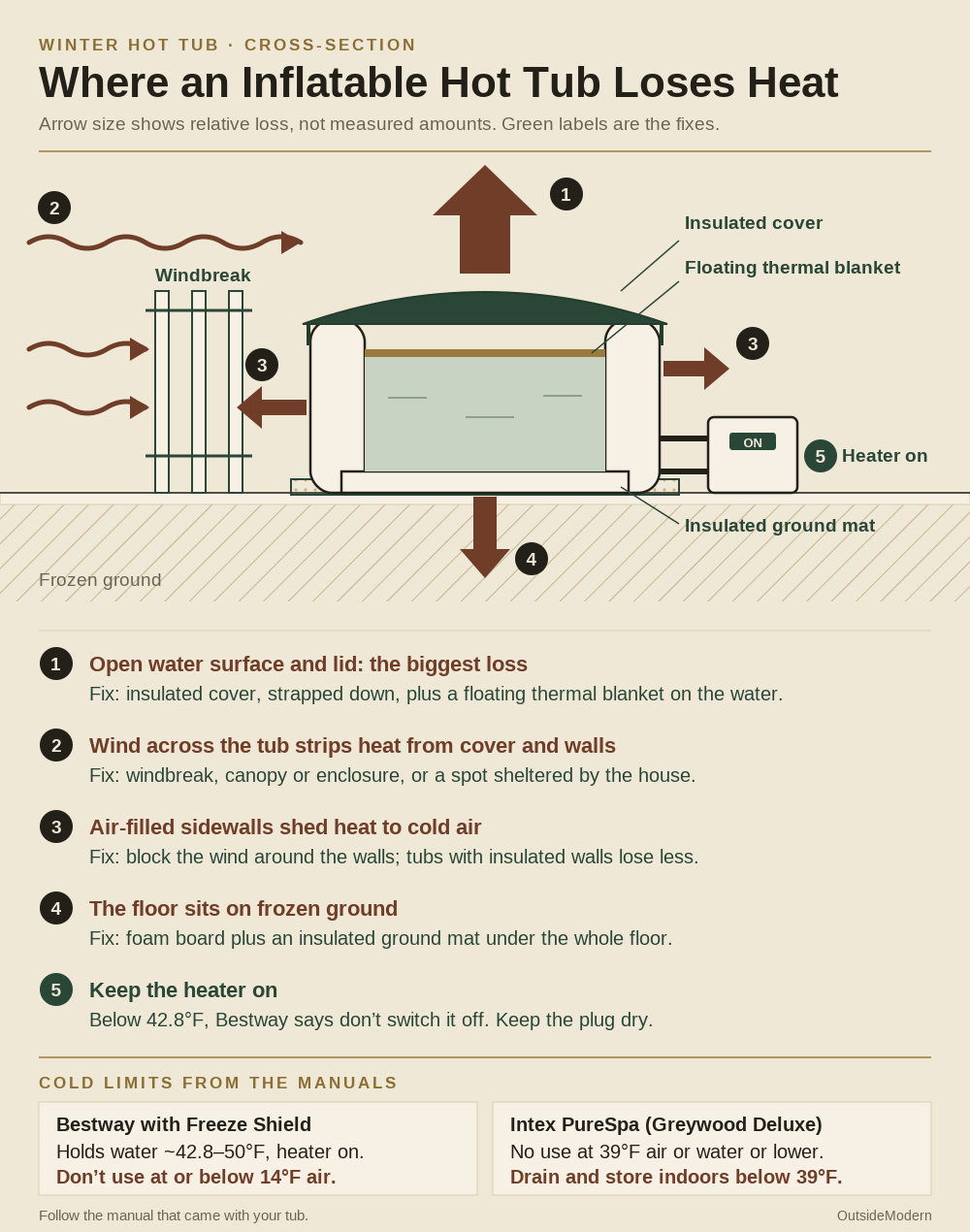
Most inflatable hot tubs come with a ground cloth or mat that sits between the ground and the spa. On frozen ground, that thin layer doesn’t do much, so the first step is to beef up that barrier. Intex itself tells owners to put a temp barrier mat between the spa floor and the ground to cut heat loss from the bottom.
We like 1 in rigid foam board insulation (EPS) for this. You can find it at your nearest home improvement store, usually in 4 x 8 ft or 4 x 4 ft sheets. Most likely you will need at least two sheets, depending on the size of your tub.
Find the radius of your tub. If you recall from math class, that’s the distance from the edge of the tub to the center. You can measure across the spa at its widest point and then divide by two, or just look up the specs of your spa. Make sure you have enough board to form a complete base under the tub.
Cut to size
You want to make your foam board insulating base just the size of your spa, or just a little bigger. An easy way to cut a proper circle is to press a nail into the board and tie a string or some fishing line to the nail, approximately the radius of the spa. Make the string taut, and use a razor knife or X-Acto knife to cut the foam insulation in a nice circle. If you need two sheets, you can tape them together with duct tape. (Square tub? Even easier: just measure and cut straight lines.)
Slip the foam board under the tub
This is much easier to do if your spa is empty, so you may want to get it done when you’re replacing your water anyway. Put the ground mat down, then place the insulation on the mat, then set the spa on top of the insulating board. Interlocking foam floor mats on top of the board add a little cushion and one more layer between the tub and the cold.
Or add a ready-made floor protector
If you’d rather not cut foam, Bestway sells its own interlocking Lay-Z-Spa Floor Protector (60334) for inflatable tubs. It’s a thin polyethylene layer, 77 x 77 in, with a separate pad for under the heater pump. Lay-Z-Spa says it minimizes heat loss through the tub’s base, and retailers call it an added layer of protection and insulation, but Bestway doesn’t publish a thickness or an insulation rating, and some owners say it’s thinner than they expected. Treat it as liner protection that cuts a little ground heat loss. It goes on top of a proper base, never on bare grass or dirt, and you can stack it: foam board, then the protector, then the tub. Tubs larger than 77 in across may need more than one set.
Bestway Lay-Z-Spa Hot Tub Floor and Yard Protector, 77 x 77 in (60334)
Bestway's interlocking polyethylene floor protector for inflatable hot tubs up to 77 x 77 in, with an extra pad for under the heater pump.
What we like
- Made by Bestway for its inflatable spas
- Interlocking pieces lay flat over a level base
- Includes a pad for under the heater pump
- Protects the liner floor from grit
Worth noting
- Bestway gives no thickness or insulation rating
- Tubs over 77 x 77 in need more than one set
- Water can seep through the gaps between pieces
2. Use a thermal cover (and a floating blanket)
Most of a tub’s heat leaves through the top, so the cover does the heavy lifting. Both big makers say the same thing: Bestway says to keep the cover on whenever the heater is running, because leaving it off increases heating time, and Intex says to always keep the cover on between uses to minimize heat loss.
The cover is a safety device, too. Keep the lid on and secured whenever the tub isn’t in use, and never leave the tub uncovered. Intex’s US owner’s manual says to put the cover on and lock all the buckles whenever the spa isn’t in use, and to stay off the cover because it won’t support your weight. MSpa’s manual says to lock the spa with its cover after each use.
An insulated thermal cover over the standard lid is the simplest upgrade. Bestway’s SaluSpa EnergySense Thermal Cover adds a double insulating layer with a waterproof top and a zippered door for the pump. Bestway says it’s up to 40% more energy efficient (that’s the maker’s claim, not our test). The 71 in version fits round Bestway and Coleman tubs that measure 71 in across and 26 in high, and there are separate square and larger round sizes, so match both dimensions on your tub’s label.
Bestway SaluSpa EnergySense Thermal Spa Cover
Bestway's double-layer insulated over-cover for SaluSpa, Coleman and Lay-Z-Spa tubs, sold in round and square sizes, with a zippered pump door.
What we like
- Double insulating layer over the standard lid
- Zippered door clears the pump connection
- Bestway rates it up to 40% more energy efficient
- Round and square sizes for Bestway and Coleman tubs
Worth noting
- Each size fits only a matching shell, so check diameter and height
- Efficiency figure is Bestway's claim, not our test
Intex owners should look at Intex’s own 28523E Energy Efficient Spa Cover instead. Intex sells it for its 4-person round Bubble Massage PureSpa models. It’s an insulated replacement lid with high-density foam and a locking buckle belt, and Intex says it can improve energy efficiency by as much as 50% (the maker’s claim). Intex’s 4-person shells vary in size from series to series, so check your model in Intex’s fit list before you buy.
Intex 28523E PureSpa Energy Efficient Spa Cover (4-Person Round)
Insulated replacement lid with high-density foam and a locking buckle belt for Intex 4-person round Bubble Massage PureSpa inflatable hot tubs.
What we like
- Made by Intex for 4-person round PureSpas
- High-density foam insulates better than a thin lid
- Locking buckle belt keeps it closed
- Intex claims up to 50% better efficiency
Worth noting
- Fits only 4-person round Bubble Massage PureSpas
- Efficiency figure is Intex's claim, not a test
- 1-year warranty at most
Own an MSpa, a Wave or a store-brand tub? CleverSpa’s universal thermal covers are insulated over-covers sold by maximum tub size, in round, hexagonal and square versions, with a zip-off door for an external pump. “Universal” means a loose fit up to the stated size, not a tailored one, and the specs we found come from retailers rather than CleverSpa. Keep your tub’s own locking lid in place underneath.
CleverSpa Universal Thermal Hot Tub Cover
CleverSpa's universal insulated over-cover for round, hexagonal and square inflatable hot tubs, sold by maximum tub size, with a zip-off door for an external pump.
What we like
- Fits many brands up to its stated size
- Round, hexagonal and square versions
- Zip-off door for an external pump
Worth noting
- Loose fit, not tailored to your tub
- Specs come from retailers, not a CleverSpa page we read
- Any efficiency figure is the seller's claim
A floating thermal blanket on the water under any cover helps too. For more options, see our guide to the best hot tub covers.
3. Block the wind
Wind pulls heat off the water surface and the walls fast. Intex lists wind above about 8–12 mph as one of the causes of slow heating. Bestway suggests setting the tub close to the house under some shelter, or using a canopy to block cold air coming in from the side.
A fence panel, a privacy screen or a pergola all help. We have plenty of ideas in our roundup of inflatable hot tub surround ideas.
For full shelter, Bestway makes the Lay-Z-Spa Dome (60305), a tent-style gazebo about 12.8 ft square that fits over inflatable tubs up to 12 ft across, with fabric and mesh doors on all four sides. It keeps the wind off the water and off you, but it’s still a tent. Bestway’s manual says: “Make sure ventilation openings are open all the time to avoid suffocation.” It also says: “Keep all flames and heat sources away from dome fabric.” The manual tells you to stay outside the dome when you add chemicals to the water, and Bestway says the dome may not withstand high winds. It publishes no snow rating, so brush snow off and take it down before a storm or heavy snow.
Never run a propane, kerosene or wood heater inside a dome or any enclosure. That’s a carbon monoxide and fire risk.
Lay-Z-Spa Dome 60305 Hot Tub Gazebo Enclosure
A 12.8 ft square tent-style gazebo from Lay-Z-Spa that fits over inflatable tubs up to 12 ft across, with detachable fabric and mesh doors.
What we like
- Blocks side wind on all four sides
- Fabric and mesh doors you can open or close
- Stores in its stuff sack when taken down
Worth noting
- Bestway says it may not withstand high winds
- No snow rating, so take it down in storms
- Ventilation openings must stay open
4. Keep it heating instead of reheating from cold
Inflatable heaters are slow. Intex’s and Bestway’s manuals list roughly 1–3°F per hour in their reference conditions, and it’s slower in cold or wind. Bestway’s own table puts a heat-up to 104°F, starting from 50°F water at 50°F air, at somewhere around 23 to 40 hours. Letting a tub go cold and starting over in January is a long wait.
So hold the temperature instead. Leave the heater on with the cover on between soaks. If you won’t use it for a few days, Intex suggests lowering the set temperature rather than shutting it off. Below 42.8°F, Bestway is blunt: don’t switch off the heater on a filled spa.
One Intex quirk to know in a cold snap: its US manuals say the pump hibernates automatically after 72 hours of continuous heating and shows END on the display. If your tub is struggling to reach its set temperature, check on it and restart the heater.
5. Protect the pump unit and keep snow off
The manuals we checked don’t give snow-specific instructions, so this part is our own common-sense advice: after a storm, brush snow off the inflatable lid and clear it away from the pump unit. A snow-melting walkway mat on the path out to the tub saves some shoveling, too. What Bestway does say is to keep the plug dry in wet weather and never plug in with a wet plug.
Power matters in winter too. Bestway says to plug its heater pump straight into a grounded outlet, with no extension cord or multi-plug adapter. Intex is just as firm: its US manuals say never to use an extension cord, timer or plug adapter. Intex tubs run through a GFCI plug on the power cord, and Intex says to test it before each use. If yours keeps tripping in wet weather, our hot tub problems guide covers the usual causes.
6. Check the water and the weather
Keep an eye on both the water temperature and the forecast. A floating thermometer is cheap insurance, and a wireless weather station like the AcuRite 01517 (our review, or see it on Amazon) makes it easy to watch for a cold snap from inside. Keep testing your sanitizer and pH through the winter, too.
Watch your footing getting in and out on icy ground. Wet, frozen steps and decks are slippery, so clear ice and snow from the path and steps before you soak. Sturdy hot tub steps with a grippy tread are safer than climbing over the wall.
Don’t push the water past 104°F to make up for the cold air. The CPSC says hot tub water should never be hotter than 104°F, and that pregnant women should stick to a 100°F maximum. It warns that drinking alcohol significantly raises the risk of drowning, and says anyone with heart disease, circulatory problems, diabetes or blood pressure problems should get their doctor’s advice before using a hot tub. A later CPSC warning adds: keep young children out of the tub unless an adult is supervising them constantly. Our hot tub safety guide covers temperature limits and soak times.
Freeze Protection: What Happens Below Freezing
Freeze Shield is Bestway’s automatic anti-freeze mode for its SaluSpa, Coleman and Lay-Z-Spa tubs. When the water drops below 42.8°F (6°C), the heater warms it back to 50°F (10°C) on its own, so the water doesn’t freeze.
It only works under a few conditions. The tub needs power, water and the heater left on (Bestway’s manuals say the heater “must always be on” when the air or water is below 42.8°F). Keep the cover on, too, since Bestway says to cover the spa whenever the heater is running. If Freeze Shield isn’t working, the spa shows an alarm, so check on the tub whenever the outdoor temperature is below 42.8°F. And it isn’t a license to soak in any weather: Bestway still says not to use the spa once the air reaches 14°F, and any damage from cold-weather use is the owner’s responsibility.
If you’re shopping for a tub you can leave up all winter, a Freeze Shield model is the no-DIY route.
Our pick: the Coleman SaluSpa Hawaii Energy-Efficient AirJet is a 71 x 71 x 28 in square tub for 4–6 people with 140 AirJets. It pairs Freeze Shield with Bestway’s insulated EnergySense walls and comes with its own EnergySense cover, so you don’t need to buy the thermal cover above (the round 71 in cover doesn’t fit it anyway). Owners of the Hawaii line most often praise how well it holds heat. The drawbacks are the slow heat-up common to inflatables, a short 180-day liner warranty, and some retail listings that still show the old 39°F disclaimer.
Coleman SaluSpa Hawaii Energy-Efficient AirJet 4-6 Person Inflatable Hot Tub (90558E)
A square 71 x 71 in Coleman tub for 4-6 with 140 AirJets, insulated EnergySense walls and cover, app control and Freeze Shield freeze protection.
What we like
- Freeze Shield holds water at 42.8 to 50°F with the heater on
- Insulated EnergySense walls plus an included EnergySense cover
- Bestway supports winter use down to 14°F air
- App control, 140 AirJets, seats 4 to 6
Worth noting
- Slow heat-up: Bestway lists about 2 to 3°F per hour
- Do not use at 14°F or colder, and do not set it up in the cold
- Liner warranty is only 180 days
- Some retail listings still show an older 39°F limit
Recall check: in September 2024, CPSC announced the recall of about 866,000 Bestway AirJet and HydroJet spa pumps sold with SaluSpa, Coleman and Hydro-Force inflatable spas from May 2021 to May 2024, because they can overheat and catch fire (one death reported). If you own one from those years, check the model number on the pump’s label (the recalled pumps are P05332, P05339, P05711, P05807, P07000, P07001, P05511, P07034 and P07572) against the CPSC notice and stop using it if it’s listed.
For more models, see our reviews of inflatable hot tubs with freeze protection. If you want a true four-season tub, a hard-shell plug and play hot tub is the sturdier answer.
Tubs without Freeze Shield
If your tub doesn’t have Freeze Shield, the rule is simple: never let the water freeze. Intex’s manuals say not to let the spa water freeze and not to turn the spa on when the water is frozen. Frozen water in the pump unit or plumbing is what does the damage, and Intex’s warranty excludes freeze damage.
Intex’s built-in freeze protection is meant for occasional freezing temperatures only, and the spa has to be plugged in with the GFCI reset for it to work. If extended freezing weather is coming, Intex says to take the spa down and store it. Both brands’ freeze protection needs the spa plugged in and powered. Neither manual covers power outages specifically, so if a long outage hits during a hard freeze, follow your manual’s draining steps rather than letting the water freeze.
When to Drain, Winterize and Store It
Drain and store your tub if it has no freeze protection and the air is heading to 39°F or below, if you’ll be away for an extended period during freezing weather, or if your area regularly sees long stretches near or below your brand’s limit (14°F for Freeze Shield tubs).
Here’s the routine, combining Bestway’s and Intex’s manuals:
- Power off and unplug the pump unit.
- Drain the tub. Attach a garden hose to the drain valve, open it, and lift the wall opposite the drain to get the last of the water out.
- Clean it, inside and out.
- Dry everything completely: the liner, the pump unit and the pipes. Bestway suggests using the pump to blow-dry the lines, and Intex says to drain any water left in the control base piping and air-dry the tub in the sun for an hour before folding.
- Pull the filters. Throw out the used cartridges and refit the inlet and outlet caps.
- Deflate the tub and inflatable lid using the pump’s deflate function.
- Fold loosely without sharp creases. Bestway says to fold only when it’s above 50°F.
- Store it indoors, dry and above freezing. Bestway recommends a carton box at 50–100°F, and Intex says 32–104°F. Bring the pump unit inside too.
Have fresh filter cartridges ready for spring (Intex owners can check our Intex PureSpa filters guide for the right ones), and you’re set.
Should You Add a Propane Booster Heater?
The original version of this guide walked through a DIY “hack”: a portable propane tankless water heater (the Eccotemp L5), a 12V pump, a timer and two hoses that circulated tub water through the heater. We no longer recommend it, and we’ve removed the build steps and parts.
Here’s why:
- It doesn’t work in the cold. Eccotemp’s manual says the L5 “can not work under 32°F.” It won’t help on the days this guide is about.
- It can’t run on its own. The manual says not to leave it unattended, and it has a 20-minute automatic shutoff. By our estimate from Eccotemp’s own temperature-rise table, a 20-minute run adds only about 3–4°F to a 250–300 gallon tub, before heat loss to cold air. (Our 2017 claim of 2–3°F per minute was wrong.)
- Carbon monoxide. It’s an open-flame appliance for outdoor use only, never in an enclosure, and it needs clearance from anything flammable.
- Scald risk. It puts out water up to 120°F, while 104°F is the safe limit for a hot tub.
- It voids warranties. Eccotemp’s warranty says the heater “shall not be used as a pool or spa heater,” and also excludes use in a circulation loop. On the tub side, Intex says attaching accessories not supplied with the kit voids its warranty, and Bestway’s warranty excludes alterations by the owner or a third party.
If your tub heats too slowly in winter, the steps above (insulation, a thermal cover, a windbreak and leaving the heater on) are the safer fix.
Frequently Asked Questions
Can you use an inflatable hot tub in winter?
Yes, within your brand’s limits. Keep the tub filled, the heater on and the cover on, and insulate underneath. Bestway Freeze Shield tubs are designed for winter use until the air reaches 14°F. Intex PureSpa manuals say not to use the spa at 39°F or below and to store it for winter where it freezes.
What temperature is too cold for an inflatable hot tub?
For Bestway SaluSpa, Coleman and Lay-Z-Spa tubs with Freeze Shield, Bestway says not to use the spa once the air reaches 14°F (-10°C). Older Bestway/Coleman tubs without Freeze Shield, and Intex PureSpa models such as the Greywood Deluxe SB-HWF20, say not to use them at 39°F (4°C) or below. MSpa’s Urban/Aurora manual also says not to use the spa outdoors below 39°F. Check the manual that came with your tub, since limits vary by model year.
What is Freeze Shield?
Freeze Shield is Bestway’s automatic anti-freeze mode. When the water drops below 42.8°F, the heater warms it back up to 50°F to keep it from freezing. It needs power, water in the tub and the heater left on, and the spa shows an alarm if it isn’t working.
Will an inflatable hot tub freeze if I leave it outside?
It can. If the heater is off or the power goes out, the water and especially the pump and plumbing can freeze, and freeze damage isn’t covered under Intex’s warranty. Either keep it powered and heating within your brand’s limits, or drain, dry and store it indoors.
Does an inflatable hot tub use more electricity in winter?
Yes, because the heater runs longer to make up for the cold air, and colder or windier weather means longer heating. No manufacturer publishes daily kWh figures. For reference, Bestway’s current SaluSpa AirJet manuals rate the heating element at 12 A on 110–120 V, which works out to about 1.3–1.4 kW while it’s firing (our calculation, not a Bestway figure). Keeping the cover on is the single biggest thing you can do to cut that run time.
Can I use a propane water heater to heat an inflatable hot tub?
We don’t recommend it. A portable propane heater like the Eccotemp L5 won’t run below 32°F, must be attended, shuts off every 20 minutes, puts out water hotter than the 104°F safe limit, and Eccotemp’s warranty excludes spa use. Adding an external heater or pump can also void your tub’s warranty.
Conclusion: Inflatable Hot Tub in Winter
You can enjoy an inflatable hot tub in winter. Keep it filled, heating and covered, insulate under it, block the wind, and stay inside your brand’s cold limit. A Freeze Shield tub makes that much easier. If your tub doesn’t have freeze protection, or a long hard freeze is coming, drain it and store it until spring.
If you haven’t bought an inflatable hot tub yet, a Freeze Shield model from the reviews we linked above is the easiest place to start.
Good luck, and happy heating!
Previously recommended
- Eccotemp L5 Portable Tankless Water Heater — no longer recommended: it won’t run below 32°F, must be attended, and Eccotemp’s warranty excludes spa and circulation-loop use. See the propane section above.
- Flojet 03526-144A 12V pump — no longer recommended: it was part of the propane booster build we’ve dropped.
- Kastar 12V 6A AC adapter — no longer recommended: it was part of the propane booster build we’ve dropped.
- JVR 12V timer switch — no longer recommended: it was part of the propane booster build we’ve dropped.
- Duda Energy 1/2 in ID hose — no longer recommended: it was part of the propane booster build we’ve dropped.
- Garden Treasures Steel Propane Tank Table Hideaway Cover — discontinued, and no longer needed now that we’ve dropped the propane booster build.