Best Electric Patio Heaters: Freestanding Infrared Picks
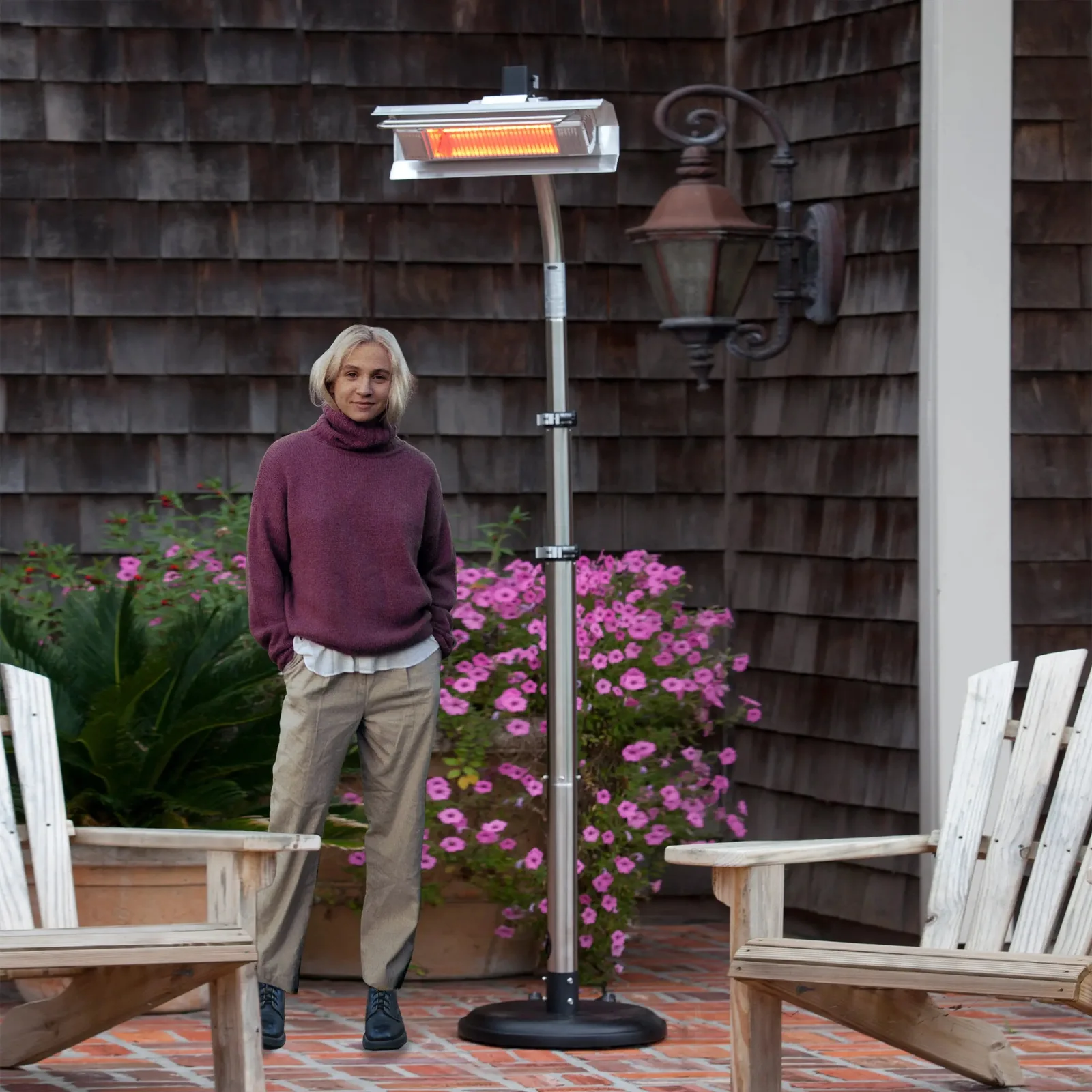
The best electric patio heaters put out a fraction of the heat that propane gas patio heaters do, but they are much easier to use. There’s no need to move around heavy propane tanks, no need to get refills from the stores, no worries about proper hose connections and safety, etc. Electric patio heaters are plug and warm! After a thorough look at the freestanding infrared heater market, our top pick is still the Fire Sense 02117 telescoping offset-pole heater.
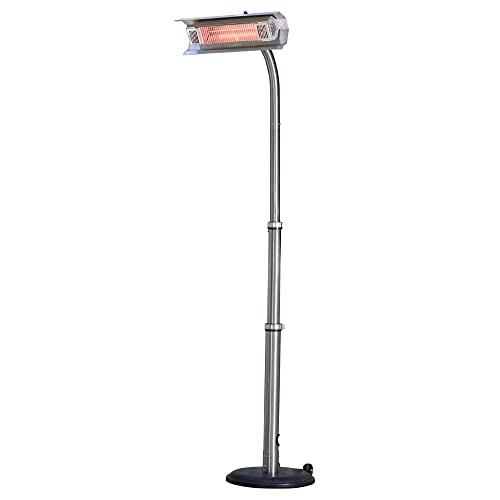
Fire Sense 02117 Telescoping Offset Pole Mounted Infrared Patio Heater With Wheels 1500…
🔥 FIRE SENSE 02117 ELECTRIC PATIO HEATER: Our patented heavy duty Stainless Steel Offset Infrared Patio Heater introduces a new revolution in outdoor heating.
The Fire Sense is well built, with a telescoping pole, an offset head that aims heat down at your seats, a heavy wheeled base and a one-year limited warranty. As electric outdoor heaters go, it’s a solid choice. We should mention that these heaters glow pretty strongly, so if you don’t want bright light, consider another style of heater (more on glare below).
Our picks at a glance: the Fire Sense for one or two people, the Hiland (AZ Patio Heaters) ZHQ1821SH for a small group, the Briza 1,500W carbon heater if you want low glare and a remote, and the Westinghouse WES31-1550 for a patio that sees rain. What’s changed since our last update: two older picks are gone, and we’ve added a full section on safe placement, outlets and weather ratings. Our picks are based on manufacturer manuals and specs, expert roundups and owner reviews, not our own hands-on testing.
This page covers freestanding heaters you set on the patio and plug into a standard outlet. If you want a wall, ceiling, tabletop or umbrella heater instead, see Other Styles below. And if you’re looking for outdoor heating inspiration, be sure to check out our mega guide to patio heating!
Best Infrared Patio Heater for Groups
The Hiland ZHQ1821SH from AZ Patio Heaters is our runner up. It uses an omnidirectional design, sending heat out in all directions, more like a typical propane heater. Given these heaters only put out about 1/8 of the heat of a propane heater, it makes more sense to us that they be directional, which is why we chose the Fire Sense over this one.
However, if you figure you’ll often have 3 or more people around the heater, then an omnidirectional heater may be more useful to you, and this one is a good choice. It is also 1,500 watts, has a telescoping pole and a tilting head, and the manual for this model code lists three heat settings.
Quick Comparison
| Product | Style | Heat pattern | Settings | Height | Weather rating (per maker) | Tip-over shutoff | |
|---|---|---|---|---|---|---|---|
| Fire Sense 02117 Telescoping Offset Pole Mounted Infrared Patio Heater With Wheels 1500… Best overall | Offset pole, wheeled base | Directional | On/off | About 72-93 in | No IP code; keep out of rain | Yes, past 15 degrees | Price |
| Hiland ZHQ1821SH 1500 Watts Electric Heaterfor Indoor or Outdoor, Silver Best for groups | Post with tilting head | 360 degrees | 700 / 800 / 1,500 W (per manual for this model code) | About 76-89 in | No IP code; shower-proof, not for use in rain | Yes | Price |
| Briza 1,500 W Carbon Infrared Electric Patio Heater with Stand (wall/ceiling mountable) Low glare, remote | Tripod stand (wall/ceiling brackets included) | Directional | 3 levels, remote, 1-9 h timer | 43-85 in | IP55 | Yes | Price |
| Westinghouse WES31-1550 Pole-Mounted Infrared Electric Outdoor Heater, 1,500 W Rain-rated pole heater | Pole on weighted base | Spot heat for one seating area | On/off | 65-73 in (44-52 in without center pole) | IP55 (product page) | Yes | Price |
All four run on a standard 120V outlet at 1,500 watts, and none of them should share that outlet’s circuit with another big load. More on that below.
Electric Patio Heaters – What To Look For
An electric patio heater is a plug-in or hardwired infrared heater that warms people and surfaces directly instead of heating the air. Most freestanding models are 1,500 watts on a standard 120V outlet, roughly 5,100 BTU per hour, which comfortably warms one seating group rather than a whole patio.
How Much Heat 1,500 Watts Really Gives
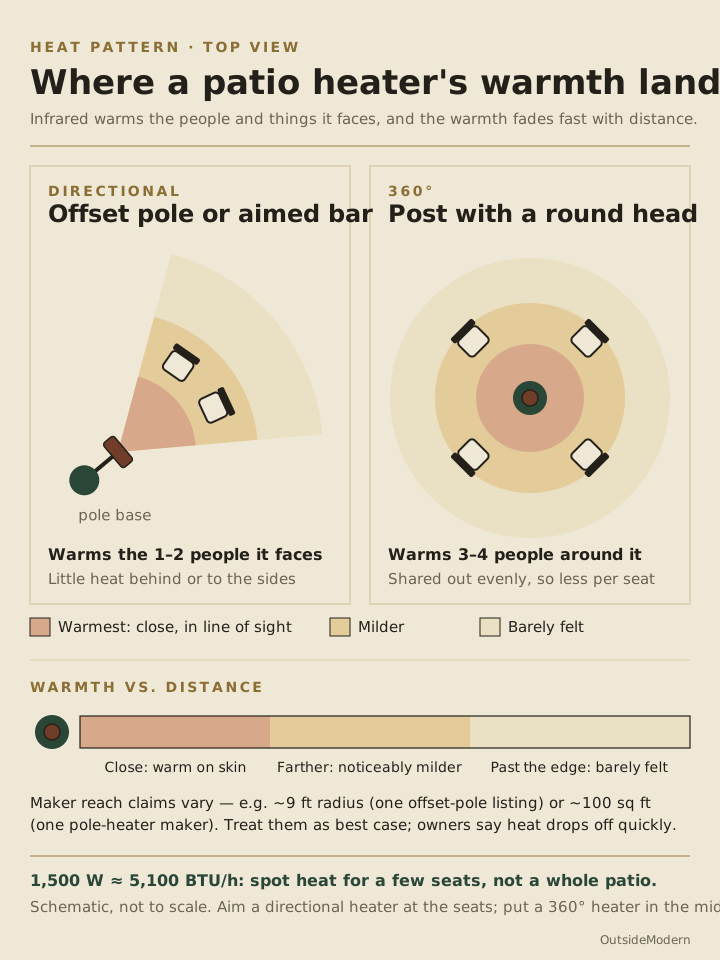
A 1,500-watt heater puts out roughly 5,100 BTU of heat per hour if you were to put it in propane gas terms (for reference, many propane gas patio heaters put out 40,000 BTU of heat). That’s not a whole lot of heat, but it is something, and it comes with the convenience of not needing to swap out propane bottles. If you really need to heat a big patio, gas is still the way to go.
Infrared heat is also less affected by wind than the warm air a propane heater puts out, because it warms you and the furniture rather than the air around you. A breeze won’t carry it off, though it won’t turn 1,500 watts into a bonfire either. To block the wind and stay cozy, pair the heater with screens and blankets.
Manufacturers’ reach claims vary a lot. Fire Sense advertises a 9-foot “blanket of heat,” and Westinghouse claims about 100 sq ft for its pole heater. Treat those as best-case numbers. Owners of the Briza report that heat falls off quickly with distance, and in practice you should plan on warming one seating group, not the whole patio.
That’s why the heat pattern matters. A directional heater (an offset head or an angled bar) puts all of its modest output where one or two people are sitting. A 360-degree post heater spreads it around a ring of three or four chairs, so each person gets a bit less. Pick the pattern that matches how you actually sit outside.
Power: 120V Plug-In vs 240V Hardwired
A 1,500-watt heater on a 120V outlet draws about 12.5 amps. That’s most of a standard 15-amp circuit, which is why plug-in patio heaters top out at about 1,500 watts, and why two of them on one circuit will trip the breaker.
If you want more electric heat than that, the step up is a 240V hardwired heater. Units like Bromic’s Tungsten electric line (2,000 to 6,000 watts) and Infratech’s WD-4024 (4,000 watts) put several times the output on one circuit. The catch: they need an electrician, their own properly sized circuit and breaker (the electrical code treats fixed heaters as a continuous load and sizes the wiring at 125% of it), and nearly all of them mount on a wall or ceiling.
We don’t review those here. For that style, see our guide to wall- or ceiling-mounted infrared heaters.
GFCI Outlets, Circuits and Extension Cords
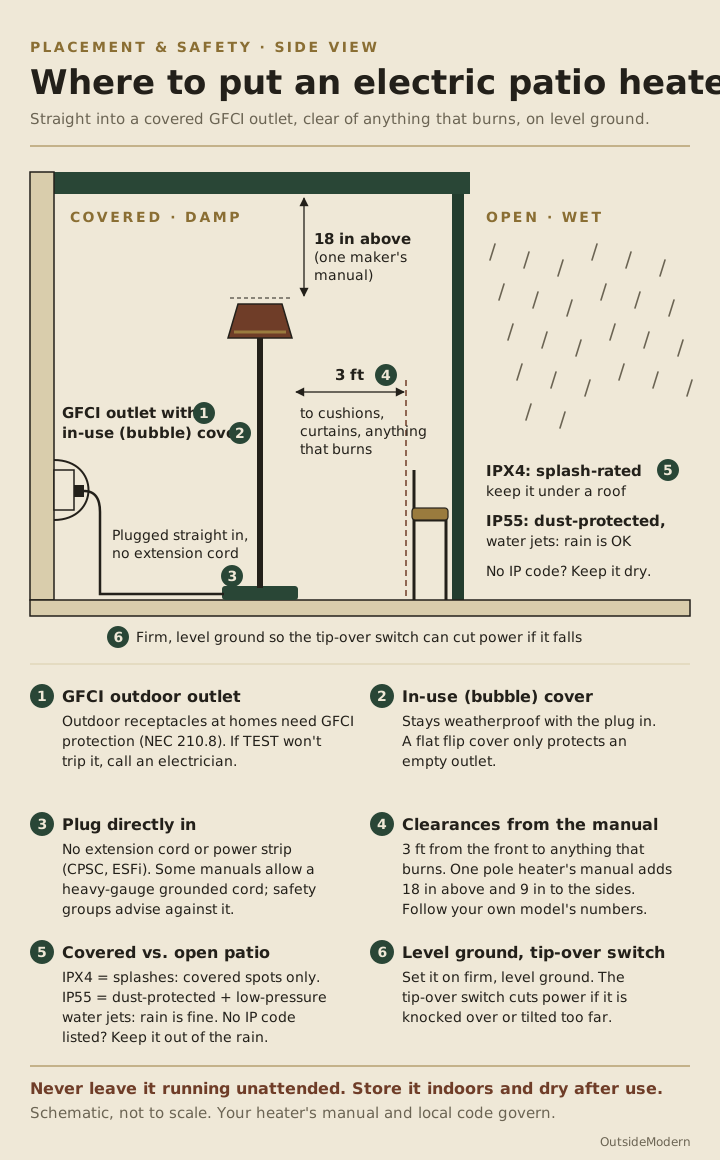
Earlier versions of this article were too relaxed about cords and outlets, so here is one rule for every heater on this page: plug it directly into a GFCI-protected outdoor outlet, give it a circuit to itself, and skip the extension cord.
The National Electrical Code has long required GFCI protection for outdoor receptacles at homes (NEC 210.8(A)(3)). It also requires an “in-use” (bubble) cover on outdoor receptacles in wet locations, one that stays weatherproof with a plug inserted (NEC 406.9(B)(1)). Those are two separate rules, and one doesn’t satisfy the other. A flat flip cover only protects an empty outlet. If your outdoor outlet doesn’t pass its trip test, or keeps tripping with the heater on it, unplug the heater and have an electrician check the outlet or the heater. Never bypass a GFCI.
The CPSC and the Electrical Safety Foundation (ESFi) both say to plug space heaters directly into a wall outlet, not an extension cord or power strip. The Briza manual says the same, flatly. Some manuals allow a heavy-gauge cord as a fallback (Fire Sense names a 12- or 14-gauge cord rated for 1,900 watts or more, and Westinghouse a grounded 14-gauge cord rated 1,875 watts or more), but both treat it as a last resort. We’d follow the CPSC and put the heater within reach of the outlet. The Fire Sense listing also calls for a dedicated 15-amp circuit, which is good advice for any 1,500-watt heater.
- Plug into a GFCI-protected outdoor outlet with an in-use cover
- No extension cords or power strips, and one heater per circuit
- Use a heater rated for the spot: covered porch vs open patio
- Keep 3 ft clear in front and follow the manual's overhead and side gaps
- Set it on level ground, keep the tip-over switch working, and never leave it running unattended
Covered vs Open Patios: Wet Ratings and IP Codes
Electricians split outdoor spots into two kinds. Under a solid roof, like a covered porch, is a damp location. An open patio that gets rained on is a wet location. Match the heater to the spot, and be wary of anything sold as “waterproof” without a code to back it up. None of the heaters on this page is rated waterproof.
The code to look for is the IP (ingress protection) rating, defined by the IEC 60529 standard. The first digit is protection from solids and dust, and the second is protection from water:
| Rating | What it means | Where it belongs |
|---|---|---|
| IP24 / IP34 | Keeps out fingers (IP2X) or tools (IP3X); splashing water only | Covered spots only |
| IPX4 | Splashing water from any direction; dust not tested | Covered spots only |
| IP54 | Dust-protected; splashing water | Covered spots |
| IP55 | Dust-protected; low-pressure water jets | Built to take rain on an open patio; check the manual for limits |
| IP65 | Dust-tight; water jets | Exposed spots; check the manual for limits |
An IP code tells you how the housing was tested, not where the maker says you can use it, so the manual always gets the final word. One 1,500-watt heater we researched for our garage heater guide is listed as IPX4, yet its manual says not to use it outdoors at all.
Of our picks, the Fire Sense publishes no IP code, and its manual says to keep it away from water. The Hiland’s manual calls it shower-proof but says not to use it in rain. Both belong under a roof. The Briza (IP55 in its manual) and the Westinghouse WES31-1550 (IP55 per Westinghouse’s product page) carry the rating that covers rain, so they’re the two we’d consider for an open patio. Neither manual spells out running them in the rain, though. Both makers say to store them somewhere dry between uses, and the Westinghouse manual says to store it in its original box. A patio heater cover helps between uses, but it doesn’t make a heater rain-rated.
Clearances and Placement
Keep anything that can burn (cushions, curtains, outdoor rugs) at least 3 feet from the front of the heater. The CPSC, ESFi and the Westinghouse manual all agree on that number, and Fire Sense asks for 3 feet at the front, top and sides. Keep umbrellas and awnings out of that zone as well.
Overhead and side gaps vary by model, so follow your own manual rather than a rule of thumb. For example, the Westinghouse WES31-1550 manual asks for at least 18 inches above the head and 9 inches to the sides. Briza asks for about 39 inches in front and 20 inches from walls, and at least 8 feet off the ground if you ceiling-mount it.
Set the heater on level ground. Every pick here has a tip-over switch that cuts power if it’s knocked over or tilted too far, and the Westinghouse manual notes it only works properly on level ground. The heads get hot, so keep kids and pets back. The Fire Sense and Westinghouse manuals both say never to leave the heater running unattended, and Westinghouse says to wait 10 minutes after switching it off before touching it.
Glare and Light Output
The heaters on this page double as lights, and that’s not always welcome. Quartz-halogen heaters like the Fire Sense glow a bright orange-red. If you’re going for torch-lit ambiance or a citronella lantern mood, one of these will throw that vibe off.
Carbon-element heaters like the Briza are generally sold, and described by owners, as a softer glow. Gold-tube elements are marketed as lower-glare too. No maker publishes a lumen number for this, so take the comparisons as a general guide.
Other Styles: Wall, Hanging, Tabletop and Umbrella Heaters
- Wall, ceiling and hanging heaters: see our wall-mounted patio heater guide. That’s also where the 240V heaters live.
- Tabletop heaters: see our tabletop patio heater roundup.
- Umbrella heaters that clip to a patio umbrella pole: see our umbrella patio heater reviews.
- Also consider: Westinghouse also sells a slim 1,500-watt gold-tube heater with a flame effect (WES31-1588), a lower-glare option for a covered corner, though we couldn’t confirm its outdoor rating in the manual.
Infrared Patio Heater Reviews
In this section, we will look closely at several infrared patio heaters, and compare the pros and cons.
1. Fire Sense 02117 Telescoping Offset Pole Infrared Heater
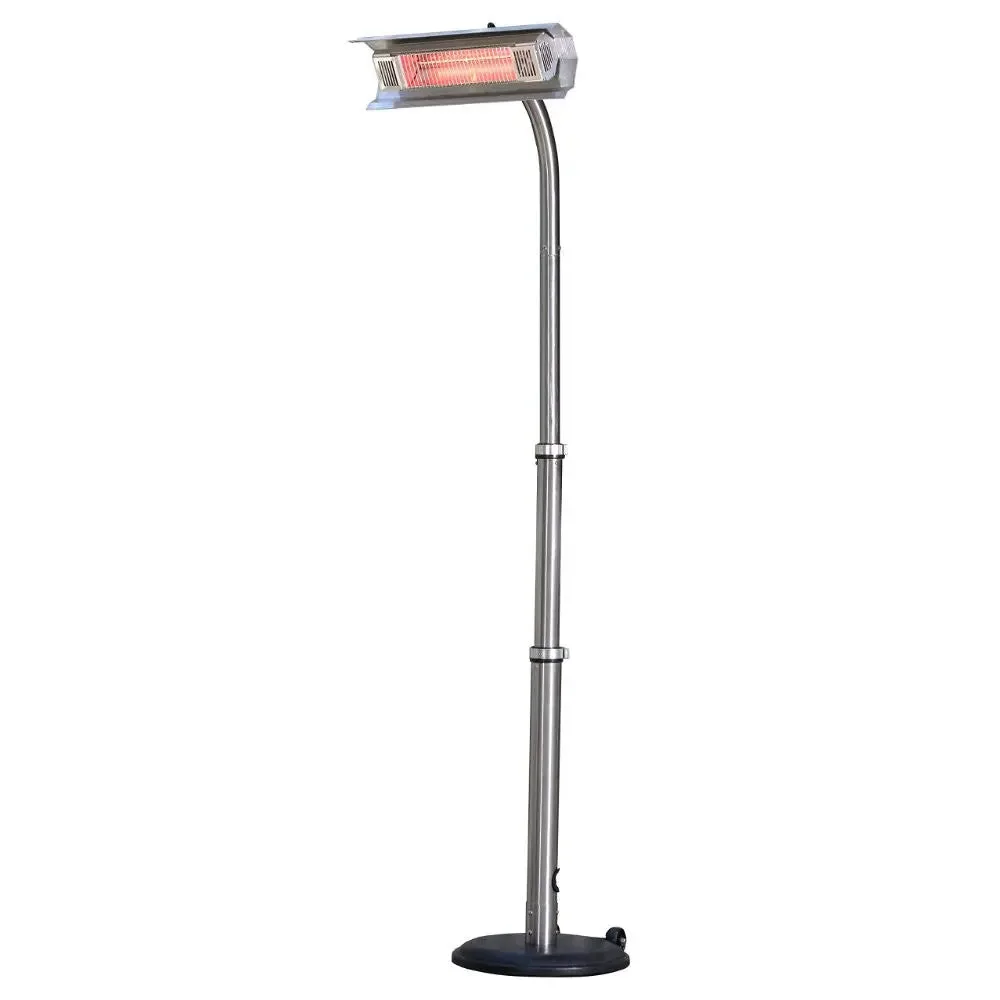
The Fire Sense 02117 telescoping offset infrared patio heater is a simple, directed heater that puts out a good deal of light and some heat. The head hangs from a curved arm, so you can roll the base beside a pair of chairs and have the heat come down on them. With 1,500 watts on a standard 120V plug, it will not put out a huge amount of heat, but the output is not negligible. Fire Sense advertises a 9-foot blanket of heat.
The light output from this heater is not insignificant, so be prepared to have a French Fry Lamp red glow on your patio! For those who like to keep light levels to a minimum for ambiance, or for star gazing, it may be troublesome due to its brightness.
Features
The controls are pretty simple: a pull/push switch on the head, and full power output all the time. There is no thermostat and no low setting. A tilt switch cuts the power if the heater is knocked over or leans past 15 degrees, and the stand is quite substantial (about 52 lb) and has wheels for ease of movement. A vinyl cover for the head is included.
It will only cover a couple of people that the heat is directed toward. To heat more than that you’ll need multiple heaters, and each one draws about 12.5 amps, so they can’t share a circuit. The listing calls for a dedicated 15-amp circuit. The cord is about 6 feet long, and the manual says to avoid extension cords and to use a GFI outlet outdoors.
Setup and Use
The height is adjustable on this infrared patio heater, but the manual recommends running it fully extended when in use, and only lowering it for storage once it’s off and cool. That makes it a little less flexible for people sitting beneath it, and you’ll want a porch ceiling high enough to keep 3 feet clear above the head.
Fire Sense says it can be used indoors or outdoors, but the manual has no rain rating and says to keep it away from water and store it somewhere dry and out of the weather. That makes it a covered-porch heater. Owner reviews at retailers are generally positive about the sturdy build and easy assembly, and say it takes the chill off for one or two people on a still, cool evening. The black version is sold as a separate model, the 02678.
Fire Sense 02117 Telescoping Offset Pole Mounted Infrared Patio Heater With Wheels 1500…
🔥 FIRE SENSE 02117 ELECTRIC PATIO HEATER: Our patented heavy duty Stainless Steel Offset Infrared Patio Heater introduces a new revolution in outdoor heating.
What we like
- Offset arm aims heat down onto a seating area
- Telescoping pole and wheeled base move easily
- Tilt switch cuts power past 15 degrees
- Simple on/off operation, instant heat
- Cover included
Worth noting
- On/off only, no heat settings or remote
- Quartz-halogen lamp glows bright orange
- Directional: warms one or two people, not a group
- No published IP rating; keep out of rain and store covered
2. Hiland ZHQ1821SH Electric Patio Heater (AZ Patio Heaters)
The Hiland ZHQ1821SH is a simple, unobtrusive 1,500-watt electric heater from AZ Patio Heaters’ Hiland line, good for covered patio use. It looks an awful lot like a common torch lamp, found in millions of houses: a stainless pole with the heat elements around a head at the top. This heat is omnidirectional, which is nice when you plan to have people standing around the heater, or several people sitting at a table by the heater.
A word of caution on the paperwork. We couldn’t find a Hiland-branded manual or an AZ Patio product page for this exact model, so the specs here come from the Amazon listing and from the 120V manual for the same model code sold under another brand. Owner reviews of this exact model are also thin, so we can’t point you to a clear consensus.
Features
The listing says “IP Certified Water Proof,” but there’s no IP code behind that, and the manual for this model code says it is shower-proof and should not be used when it’s raining or wet. So, despite what we said in an earlier version of this article, it is not a heater for an open, rained-on deck.
The manual lists three heat settings (700, 800 and 1,500 watts) on a switch on the head, which is more than we gave it credit for before. Realistically, you’ll want it on high most of the time.
Setup and Use
One of the nice features of this patio heater is the adjustable height. The telescoping pole runs from about 76 to 89 inches per the manual, and the head tilts, offering directed heating when needed. It also has an anti-tilt safety switch, and the manual says to only operate it upright.
It plugs into a grounded 120V outlet. At about 32 lb it’s light enough to move around a porch. AZ Patio documents a one-year limited warranty on its Hiland electric heaters, though we couldn’t find the warranty card for this model.

Hiland ZHQ1821SH 1500 Watts Electric Heaterfor Indoor or Outdoor, Silver
Adjustable Electric Heater. IP Certified Water Proof
What we like
- Surrounds the head with heat for a small group
- Telescoping pole plus a tilting head
- Three heat levels (700/800/1,500 W per manual)
- Anti-tilt safety switch
- Light enough to move around a porch
Worth noting
- No published IP code; not for use in rain
- Manufacturer documentation is hard to find
- No remote or timer
- 1,500 W only warms people close to the head
3. Briza 1,500W Carbon Infrared Heater with Stand
The Briza is a slim, 35-inch carbon infrared bar on a tripod stand, and it replaces the e-joy KingMys we used to list in this spot. It fills the same niche, a heater that can stand now and go on a wall or ceiling later, with a better weather rating. This Old House picked it as its best infrared heater.
It has three heat levels and a remote with a 1-to-9-hour timer. The KingMys remote seemed kinda pointless to us, but a timer is genuinely handy when you want the heater to shut itself off at the end of the evening. Carbon elements are sold as a softer glow than quartz-halogen, and owners generally agree, so this is our pick if glare bothers you.
Features
The Briza manual lists an IP55 rating, which means dust-protected and resistant to low-pressure water jets. That ties the Westinghouse for the best rating among our picks. The manual still says to store it in a cool, dry place when you’re not using it, and recommends a weatherproof outlet outdoors. It also has a tip-over shutoff.
The manual is blunt about power: plug it directly into a wall outlet, and never use an extension cord or power strip. The cord is about 7 feet according to the retail listing, and one owner called it shorter than they’d like, so plan your spot around the outlet.
Setup and Use
The tripod adjusts from 43 to 85 inches. Wall and ceiling brackets are in the box, and if you mount it, Briza asks for at least 20 inches from adjacent walls and at least 8 feet off the ground on a ceiling. For mounted heaters in general, see our wall-mounted patio heater guide.
Owners say it heats up fast and is good for a few people on a chilly patio, but that it won’t warm a whole open space and the heat falls off quickly with distance. A small share report the remote failing after a year or two. We couldn’t find a published warranty term or a UL/ETL listing mark for it.
Briza 1,500 W Carbon Infrared Electric Patio Heater with Stand (wall/ceiling mountable)
A slim 120 V, 1,500 W carbon infrared heater with three heat levels, a remote with timer and an IP55 rating that ships with a tripod stand plus wall and ceiling brackets.
What we like
- Three heat levels and a remote with a 1-9 h timer
- IP55-rated housing
- Tripod stand plus wall and ceiling brackets
- Tip-over shut-off
- Light (6.4 lb) and slim
Worth noting
- Warms only what is in front of it
- No thermostat
- Manual bans extension cords, and the cord is short (about 7 ft)
- No listing mark or warranty term published
4. Westinghouse WES31-1550 Infrared Pole Heater
The Westinghouse WES31-1550 is a straightforward 1,500-watt infrared pole heater on a weighted base, and it replaces the Outsunny heater we used to recommend here. Its selling point is weather resistance. Westinghouse’s product page rates it IP55 against rain and dust, which makes it the pole heater we’d pick for an open patio.
One caveat: the IP55 figure is on the product page, but the manual itself doesn’t give an IP rating. The manual also says to store the heater in its original box in a cool, dry place, so rain-resistant doesn’t mean leave-it-out-all-winter.
Features
It’s a one-switch heater: on or off, no low setting, no remote. Westinghouse claims about 100 sq ft of heating area. We’d treat that as best case and think of it as warming one seating area. It uses an infrared bulb rather than a carbon or gold-tube element, so expect noticeable glare, likely similar to the Fire Sense (we’re going by the element type here). There’s a hidden tip-over switch that cuts power if it falls, and the manual says it only works properly on level ground.
Setup and Use
Assembly is simple: three tubes screw into the base and the head attaches with three screws. You can drop the center pole section to bring the head down to 44-52 inches. The manual asks for at least 18 inches of clearance above the heater, 9 inches to the sides and 3 feet in front, and it says never to leave it running unattended.
The manual allows a grounded 14-gauge extension cord rated 1,875 watts or more if you must use one, but the CPSC and ESFi advise against extension cords with heaters, and so do we. Its cord is about 6 feet, so it needs a GFCI outlet nearby. Owner feedback on this exact model is limited, although the heater is sold widely.
If Amazon shows a “newer version” of this heater, that’s likely the WES31-2266. Its listing says only IPX4 (splash-resistant), so it isn’t a like-for-like swap for an open patio.
Westinghouse WES31-1550 Pole-Mounted Infrared Electric Outdoor Heater, 1,500 W
A 120V, 1,500-watt freestanding infrared pole heater with an IP55 rain-and-dust rating, a 65–73 in telescoping pole and a tip-over shutoff.
What we like
- IP55 rain-and-dust rating, per Westinghouse
- Telescoping pole (65-73 in), or 44-52 in without the center section
- Tip-over shutoff
- Instant radiant heat, no fuel
- Widely stocked
Worth noting
- On/off only, no low setting or remote
- Likely bright, bulb-style glare
- Manual says store it indoors in its box
- Thin owner-review record
Electric Patio Heater FAQ
Can you leave an electric patio heater outside in the rain?
Only if it’s rated for it, and even then not all season. An IP55 or IP65 heater is built to handle rain on an open patio, as long as its manual doesn’t say otherwise, while splash-rated (IPX4, IP34) heaters and heaters with no IP code belong under a roof. Even our IP55 picks, the Briza and Westinghouse, should be stored dry between uses.
Can I use an extension cord with an electric patio heater?
No, as a rule. The CPSC and ESFi say to plug heaters directly into a wall outlet, and the Briza manual bans extension cords outright. A few manuals allow a heavy-gauge grounded cord as a last resort, but you’re better off placing the heater near a GFCI outlet.
Do I need a GFCI outlet for an outdoor electric heater?
Yes. Outdoor receptacles at homes are required to have GFCI protection (NEC 210.8(A)(3)), and in wet locations an in-use cover that stays weatherproof with the plug in (NEC 406.9(B)(1)). If the GFCI keeps tripping, unplug the heater and have the outlet or heater checked. Never bypass it.
How much area does a 1,500-watt patio heater warm?
Plan on one seating group of about two to four people. A 1,500-watt heater gives roughly 5,100 BTU per hour, about 1/8 of a 40,000 BTU propane heater. Makers’ claims, like Fire Sense’s 9-foot “blanket” or Westinghouse’s 100 sq ft, are best-case figures, and the warmth falls off quickly with distance.
How much electricity does an electric patio heater use?
A 1,500-watt heater uses 1.5 kWh for every hour on high, so a three-hour evening is 4.5 kWh. On a lower setting it’s less: 900 watts uses 0.9 kWh an hour and 700 watts uses 0.7 kWh. Multiply the kWh by the rate on your electric bill to get your cost.
Is a 240V patio heater better than a 120V one?
It’s more powerful, not automatically better. A 240V heater can carry several thousand watts on one circuit, so it warms a bigger zone, but it needs an electrician, its own circuit and usually a wall or ceiling mount. If you want a heater you can roll out and plug in, 120V and 1,500 watts is the limit.
Are electric patio heaters safe under a covered patio?
Yes, and a covered patio is where most plug-in heaters belong. They burn no fuel, so there are no combustion gases to vent. Keep the manual’s overhead clearance, keep anything flammable 3 feet from the front, and never leave the heater running unattended.
Conclusion: Best Outdoor Electric Heaters
For most people, the Fire Sense 02117 is still our favorite electric patio heater. The directed heat is more practical than an omnidirectional heater, given the low heat output. If three or more people are going to be consistently around the heater, the Hiland ZHQ1821SH spreads its heat in a circle, or you may need a second heater on its own circuit. The Briza is the pick for lower glare and a remote, and the Westinghouse WES31-1550 for a patio that sees rain.
If you’re really looking to heat your patio space, a gas patio heater will certainly put out a lot more heat, but the gas heaters require a lot more effort and fuel costs, getting propane jugs filled, changing out jugs, etc.
If you don’t want to deal with that, then one of these electric patio heaters will serve you well, as long as you understand the limits of the heating capacities of these units and plug it into the right outlet.
Previously recommended
- e-joy KingMys 1,500W carbon infrared heater: still sold, but we now recommend the Briza 1,500W (#3) for the same stand-or-wall flexibility and a better weather rating.
- Outsunny 1,500W freestanding heater: no longer available; we now recommend the Westinghouse WES31-1550 (#4) instead.