Best Polytunnel Greenhouses: Walk-In Tunnel Kits Compared
A walk-in polytunnel is the cheapest way to get a lot of covered growing space. It’s a row of steel hoops with a plastic cover pulled over the top, and you plant straight into the ground underneath. The catch is that a tunnel this light lives or dies by how well you tie it down.
For this update we went back to the makers and to university extension guides. None of the kit makers we checked publishes an engineered wind or snow rating (the Outsunny version we match to our listing doesn’t either), so we don’t give any of these tunnels an award. Instead, each pick below lists what its maker actually states, and the anchoring, venting and snow advice comes from extension sources. We haven’t tested these tunnels ourselves; where we mention owner experience, we say so.
What’s changed: two of our old picks are gone (their listings are dead), and the Best Choice Products tunnel is no longer sold by its maker. Quictent and Strong Camel picks now point to their 20 ft tunnels, a smaller Gardman tunnel joins the list, and we’ve added a section on wind, snow and anchoring. For smaller covered spaces, see our mini greenhouse guide.
Our picks at a glance:
- Two-door walk-in tunnel: OGrow Deluxe Walk-In Tunnel Greenhouse, with a door at each end for a through-draft.
- One-door tunnel with a stated cover spec: Outsunny 15’ x 7’ x 7’ Walk-In Tunnel Greenhouse, the one maker copy here that states a cover weight.
- Two-door, 20 ft tunnel: Quictent 20’ x 10’ x 6.6’ Walk-In Greenhouse.
- Long one-door tunnel: Strong Camel 20’ x 10’ x 7’ Portable Greenhouse.
- Smaller walk-in, about 10 ft: Gardman 7624 Poly-Tunnel.
| Product | Size | Doors | Windows | Cover | Wind or snow rating | |
|---|---|---|---|---|---|---|
| Ogrow® Deluxe Walk-in Tunnel Greenhouse with Cover - White Two-door walk-in tunnel | 180 x 72 x 72 in frame (maker) | 2, one at each end | 4 mesh roll-up | Mesh PVC (maker) | None published | Price |
| Outsunny 15' x 7' x 7' Walk-in Tunnel Greenhouse… One-door tunnel with a stated cover spec | About 14.6 ft long, 6.6 ft wide and high (maker) | 1 | 6 mesh roll-up (maker) | 140 GSM PE (maker) | None published for this version | Price |
| Quictent 20' x 10' x 6.6' Walk-In Greenhouse Two-door, 20 ft tunnel | 20 x 10 x 6.6 ft (listing name) | 2 zippered | Not confirmed | Not confirmed | None found | Price |
| Strong Camel Portable Greenhouse Large Walk in Green Garden Hot House Outdoor Plant… Long one-door tunnel | 20 x 10 x 7 ft (listing) | 1 zippered | 8 roll-up with screens (listing) | Not stated by a maker page | None found | Price |
| Gardman 7624 Poly-Tunnel with Reinforced Cover & Windows… Smaller walk-in, about 10 ft | 118.11 x 78.74 x 74.80 in (listing) | Not confirmed | Yes, count not confirmed | Not confirmed | None found | Price |
Polytunnel Greenhouses – What To Look For
What is a polytunnel greenhouse?
A polytunnel is a structure for growing plants under cover. Instead of the square frame of a traditional greenhouse, it’s a long, rounded tunnel: steel hoops with a plastic cover over the top. Polytunnels are pretty similar to tents, soft-top gazebos and pop-up gazebos, as all have the same basic metal frame with a cover.
The word covers a wide range of sizes, and it helps to know which kind you’re reading about:
- Kit walk-in tunnels (the ones on this page) are roughly 6.6 to 7 ft wide by the makers’ own figures, light enough to move, and held down with ropes and stakes.
- High tunnels, the kind extension services write about, are far bigger. Cornell’s high tunnel program says hoop houses usually run “12 to 40 feet wide”, with sidewalls 4 to 6 ft tall, built from steel hoops covered by greenhouse-grade plastic.
- Low tunnels are row-level covers. Cornell puts them at about 1.5 to 2 ft tall.
That difference matters. Most of the anchoring and snow advice below was written for high tunnels, which are sturdier than any kit. We pass it on because the principles carry over, not because a kit can meet the same standard. For a side-by-side look at the two structure types, see our guide to polytunnels vs. greenhouses.
Growing in the ground
Unlike most glass or polycarbonate greenhouses, a polytunnel goes up on bare ground. That’s its biggest advantage: you can plant straight into the soil, or set raised garden beds inside, while the cover keeps off rain and holds in some heat and humidity.
It also makes a tunnel a handy shelter for tender crops and young fruit trees. Just don’t expect a heated greenhouse. Utah State University Extension says nighttime temperatures inside an unheated high tunnel “may vary by just a few degrees warmer than those outside.” A kit tunnel buys you a little frost protection and a longer season, not a tropical room.
Doors, windows and ventilation
Plastic tunnels overheat fast. In its ventilation fact sheet, UMass Extension says it “takes only a few minutes without ventilation” for a closed structure to pass 100 F on a hot day.
That’s why doors at both ends are worth having. Nebraska Extension notes that “if only the end wall doors can be opened, air movement will be limited”, and UMass says hoophouse growers find roll-up sides “work well for warm season ventilation.” Kit tunnels don’t have roll-up sides, but their roll-up mesh windows (four to eight, depending on the model) do a similar job on a smaller scale. Open the doors and windows on warm days, and close them before a storm.
Door openings usually have no mesh, so insects can walk right in. A length of insect netting such as Agfabric’s 6.5 x 10 ft garden netting can be hung over an open doorway or laid over the crops. If you want powered airflow without running a cord out to the garden, see our guide to solar-powered greenhouse fans.
If you use shade cloth in summer, UMass says it “should be porous so that the heat generated below can escape.”
Condensation and humidity
A closed plastic cover traps moisture. UMass notes that “condensation droplets reduce light transmission”, and its fact sheet on gray mold (botrytis) in commercial greenhouses says the disease needs “a film of moisture for 8 to 12 hours” with relative humidity of 85% or greater. Venting and moving air are the fix, which is one more reason to open the tunnel up whenever the weather allows.
Frame and cover
Kit frames are steel tube, either powder-coated or galvanized, depending on the maker. The hoops are joined with connectors, and the cover is tied or clipped to the frame. Take each maker’s description at face value; some listings use both terms for the same tunnel.
The cover is the part that wears out. Virginia Tech Extension says polyethylene “without additives” lasts “only one to two years”, while UV-stabilized film lasts three to four years or longer; the University of Georgia gives 1 to 3 years. Extension guides recommend greenhouse-grade film by thickness: UConn says a 4-mil grade “should be adequate in most locations” if you take it down before winter, and that “it is best to utilize the stronger 6-mil greenhouse grade” if it stays on all winter. Nebraska Extension recommends 6-mil UV-protected poly for high tunnels.
None of the kit makers we checked states its cover thickness in mils. Outsunny’s copy gives a fabric weight (140 GSM) instead, and OGrow calls its cover a mesh PVC rather than PE. So you can’t compare kit covers directly with extension film recommendations. Expect to replace a kit cover long before the frame.
Site and drainage
Pick a spot that drains. Nebraska Extension says the best high tunnel sites “are slightly elevated, with a 1 percent to 2 percent grade”, and to avoid moderate to steep slopes; it suggests drainage ditches on the uphill side. Utah State adds that you should avoid spots that lack cold air drainage, such as low pockets where frost settles.
A tunnel doesn’t need a perfectly level foundation the way a framed greenhouse does, but the frame still has to sit square, or the cover won’t fit and the doors won’t zip. For which way to point it, see what direction a greenhouse should face.
Wind, Snow and Anchoring
This is the most important part of owning a polytunnel. A kit tunnel weighs little and catches wind like a sail, and owners often report that the supplied stakes are too small. One Outsunny owner on Aosom’s site says wind “blew it over twice” before they added rebar and fence clamps.
Start with the maker’s instructions. Outsunny’s manual says: “Always secure the greenhouse using the ropes and ground nails provided when in use.” Its 845-073 tunnel comes with four pull ropes and four ground stakes. Outsunny also says the cover’s 5.9 in extended edges “are supposed to be deep buried in the soil.” OGrow includes four plastic anchors with guy ropes for the corners, plus 16 metal anchors for the perimeter.
Then add what extension services recommend for tunnels. These sources describe high tunnels, so treat them as good practice rather than a rating for your kit:
- Anchor the ends. UVM Extension says to “build strong end-walls and make sure they are anchored to the ground to prevent uplift”, and that strapping over the bows, attached at ground posts, “can help prevent uplift in high winds.”
- Use real ground anchors. Cornell says hoop houses that rest on the soil “must be secured with anchors such as ground augers with chains.” Texas A&M AgriLife recommends at least three anchors on each side of a tunnel (one at each corner and one in the middle), and notes that screw-in anchors “will loosen over time.”
- Know how deep the pros go. Cornell says high tunnel posts are driven “2 to 3 feet into the ground.” UConn’s high tunnel engineering guidance gives 24 to 30 in. Those are posts for permanent structures, far deeper than a kit’s stakes. They show why a few short pegs aren’t much for a structure this size.
- Face the end wall into the wind. The University of Kentucky’s severe-weather guide says end walls, rather than side walls, should face prevailing winds when possible.
- Close up before a storm. Cornell says keeping the roll-up sides and endwalls closed during high winds “is a must”, and Kentucky advises keeping covers tensioned, “as loose films can act like sails.”
Longer stakes can help in soft ground. EXPLOMOS forged steel tent stakes are 11.8 in long and 10 mm thick, in a pack of eight. Holding power depends on your soil, though, and they supplement the kit’s own anchoring rather than replace it.
Snow
No kit maker on this page publishes a snow load, so assume the tunnel isn’t built for one. Snow adds up fast: UConn says 3 in of wet snow or 12 in of dry snow adds about 5 lb per square foot.
You have two choices. The safest is to take the cover off. Kentucky’s guide says that where a structure isn’t designed for heavy snow, “the best proactive measure may be to remove the plastic cover entirely, roll it up, and store it safely.” If you leave it up, UConn says “2 x 4 wood posts should be placed under the ridge”, and Missouri Extension suggests temporary posts on a wide base such as a concrete block. Either way, brush snow off before it builds up.
Polytunnel Greenhouse Reviews
The five tunnels below are listed by role, not ranked by award. Every one is a soft pick: none of the makers publishes a wind or snow rating for the version we list, so anchor each one as described above.
1. Two-Door Walk-In Tunnel: OGrow Deluxe Walk-In Tunnel Greenhouse
- Doors at both ends for a through-draft.
- Four mesh roll-up windows, per the maker.
- Powder-coated steel frame with double middle rails.
- Four guy ropes with plastic anchors, plus 16 metal perimeter anchors.
- No wind or snow rating published.
OGrow is a Machrus brand, and Machrus lists this 15 x 6 x 6 ft tunnel as in stock on its own store. Its standout feature is a door at each end. Open both and you get a through-draft, which matters a lot in a plastic tunnel on a summer afternoon.
The cover is what Machrus calls a “mesh PVC cover”, described as “waterproof and UV resistant”. That’s the maker’s wording; it doesn’t publish a thickness. Note that it’s PVC, not the PE film most other kits use.
OGrow does better than most on anchoring hardware. On top of the four corner guy ropes, you get 16 metal anchors for pinning down the perimeter. Machrus says the anchor kit “will help keep your greenhouse firm against the wind”, but that’s marketing, not a rating. The maker doesn’t publish a wind or snow rating, so follow the anchoring advice above and take the cover down before heavy snow.
The drawbacks: we couldn’t find a warranty term we could rely on, because Machrus and Tractor Supply state different ones, so check the terms where you buy. The maker’s assembly manual we found was a scan we couldn’t read, and four windows is fewer than some rivals offer.

Ogrow® Deluxe Walk-in Tunnel Greenhouse with Cover - White
Tough and durable white PVC cover manufactured from heavy duty reinforced mesh material that is waterproof and UV resistant. The cover is secured to the frame with strong fabric ties
What we like
- Doors at both ends for cross-ventilation
- 16 metal perimeter anchors plus 4 guy ropes
- Sold by the maker and Tractor Supply
Worth noting
- No wind or snow rating published
- Warranty terms conflict between sellers
- Only four side windows
2. One-Door Tunnel With a Stated Cover Spec: Outsunny 15’ x 7’ x 7’ Walk-In Tunnel Greenhouse
- Maker copy gives the cover weight: 140 GSM PE.
- One zippered roll-up door.
- Six mesh roll-up windows, per the maker.
- Four guy ropes and four ground stakes.
- No wind or snow rating published for this version.
Outsunny is a brand of Aosom, which sells several versions of this tunnel on its own site. The Amazon listing’s title and six windows match Aosom’s white model 845-073, so that is the version we describe. Its maker size is roughly 14.6 ft long and 6.6 ft wide and high, so the “15 x 7 x 7” in the name is rounded up.
This is the only tunnel on our list whose maker copy gives a cover weight: 140 GSM, which is a fabric weight, not a thickness. That is the maker’s figure, not ours.
For this version the maker doesn’t publish a wind or snow rating, so anchor it as the guidance above describes. The manual is clear that you should “always secure the greenhouse using the ropes and ground nails provided”, and the cover’s extended edges are meant to be buried.
The drawbacks: one door means less airflow than a two-door tunnel. Owners on Aosom’s site say the supplied cord and stakes aren’t enough in windy areas, and one reported the tunnel blowing over twice before adding rebar. Aosom’s manual cover lists 120 minutes for assembly; owners report two to three hours. A maker Q&A notes that setting the poles into the ground adds stability but drops the height by about 4 in.
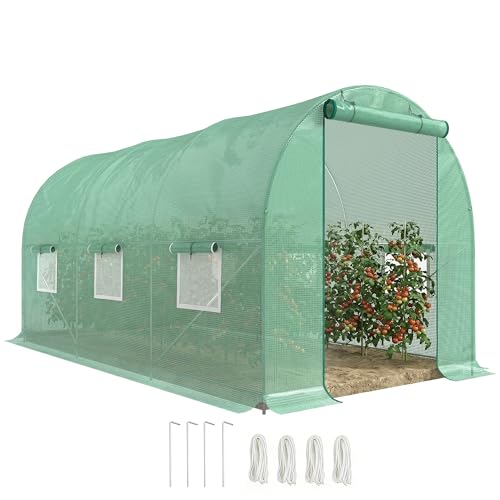
Outsunny 15' x 7' x 7' Walk-in Tunnel Greenhouse…
Walk in Greenhouse: Our backyard greenhouse is an ideal way to extend your growing season while easily managing your plants and protecting them from extreme temperatures.
What we like
- Maker copy states cover weight (140 GSM PE)
- Clear maker anchoring instructions and buried cover edges
- Sold direct by Aosom
Worth noting
- One door limits airflow
- Supplied stakes are too light for windy sites, owners say
- No wind or snow rating published for this version
3. Two-Door, 20 ft Tunnel: Quictent 20’ x 10’ x 6.6’ Walk-In Greenhouse
- The largest two-door tunnel on our list: 20 x 10 x 6.6 ft by its name.
- Two zippered doors.
- Maker site not reachable; specs not confirmed.
- No wind or snow rating found.
Quictent’s 20 x 10 ft tunnel replaces the Quictent 19.7 x 9.8 ft model we used to recommend. If you want the most floor space with a door at each end, this is the one to look at. A 10 ft width gives you room for beds down both sides with a path in the middle.
We have to be upfront: we couldn’t confirm much. Quictent’s website didn’t load when we checked, and the one retailer page we could read (Walmart) showed it out of stock. Sellers’ listings disagree on whether the frame is galvanized or alloy steel, so we print neither.
The maker doesn’t publish a wind or snow rating that we could find. A tunnel this size has a lot of cover to catch the wind, so it needs the full treatment: every stake and rope it comes with, ground anchors along both sides, end walls facing the prevailing wind, and the cover off before heavy snow.
Quictent 20' x 10' x 6.6' Walk-In Greenhouse
A 20 x 10 ft walk-in tunnel with two zippered doors. We couldn't read a maker page, so check the listing's specs and warranty.
What we like
- Two doors on a 20 ft tunnel for cross-ventilation
- 10 ft width fits beds along both sides
Worth noting
- No readable maker or still-sold page; specs unconfirmed
- No wind or snow rating found
- Large cover needs extra anchoring
4. Long One-Door Tunnel: Strong Camel 20’ x 10’ x 7’ Portable Greenhouse
- 20 x 10 x 7 ft, per the Amazon listing.
- Eight roll-up windows with screens.
- One zippered door.
- Maker website is gone; listing specs only.
- No wind or snow rating found.
Strong Camel’s old 12 ft tunnel, our former runner-up, is gone. Its 20 x 10 x 7 ft tunnel is the one still listed, and it’s a big step up in size. Per the Amazon listing, it has a powder-coated steel frame, eight roll-up windows with screens and a single zippered door.
The caveat is a big one. Strong Camel’s website now leads to a domain-for-sale page, and we couldn’t find this tunnel at any other retailer. Everything we know comes from the Amazon listing, so we can’t confirm the cover material or a warranty, and we’ve dropped the old third-party instruction link.
We found no wind or snow rating for it. With one door on a 20 ft tunnel, airflow depends on those eight windows, so open them early on sunny days. Anchor it as you would the Quictent, with extra ground anchors along both long sides.
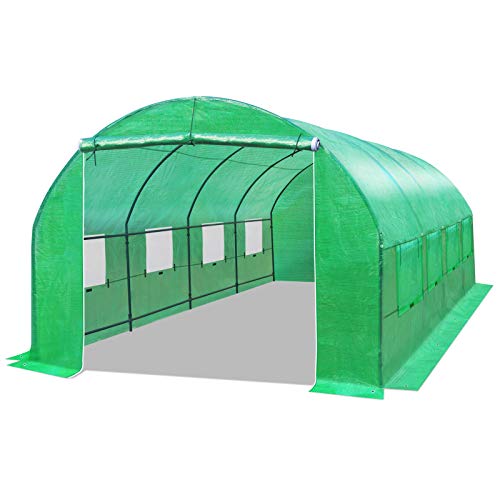
Strong Camel Portable Greenhouse Large Walk in Green Garden Hot House Outdoor Plant…
Green House Overall Dimensions:20' X 10' X 7'.
What we like
- Large 20 x 10 ft footprint
- Eight screened roll-up windows
Worth noting
- Maker website gone; listing specs only
- One door on a 20 ft tunnel limits airflow
- No wind or snow rating; warranty unconfirmed
5. Smaller Walk-In, About 10 ft: Gardman 7624 Poly-Tunnel
- About 9 ft 10 in long, 6 ft 7 in wide, 6 ft 3 in high, per the listing.
- Windows included; count not confirmed.
- Maker site not reachable.
- No wind or snow rating found.
Not everyone needs 15 or 20 ft of tunnel. The Gardman 7624 is about 10 ft long, which fits a smaller yard and is a lot less cover to hold down in the wind. At a listed 74.8 in high, most adults can stand up in the middle.
We know less about this one than we’d like. Gardman’s US website didn’t load, and the reseller pages we tried were blocked or gone, so the size above comes from the Amazon listing. The listing calls the cover “reinforced” and says no tools are needed; we couldn’t confirm either from Gardman, so check the listing before you buy.
The maker doesn’t publish a wind or snow rating that we could find. A short tunnel is easier to anchor, but the same rules apply: stake every corner, secure the ends, and take the cover off before heavy snow.

Gardman 7624 Poly-Tunnel with Reinforced Cover & Windows…
Requires no tools to assemble
What we like
- Compact, about 10 ft long
- Tall enough to stand in at the center, per the listing
Worth noting
- Maker site unreachable; listing specs only
- No wind or snow rating found
- Door and window details unconfirmed
Previously recommended
- Best Choice Products SKY1917 15x7x7 Walk-In Tunnel Greenhouse — no longer sold by its maker, with no successor; we now recommend the OGrow or Outsunny tunnels for the same 15 ft size.
- Strong Camel 12’ x 7’ x 7’ tunnel greenhouse — discontinued; we now recommend the Strong Camel 20’ x 10’ x 7’ instead.
- Quictent Galvanised 2-Door 19.7’ x 9.8’ tunnel greenhouse — discontinued; we now recommend the Quictent 20’ x 10’ x 6.6’ instead.
Assembly and Moving a Tunnel
Kit tunnels take a few hours to put up. Outsunny’s manual lists 120 minutes, and its owners report two to three hours; the other makers don’t state a time. Lay out and sort the parts first, and check the box for missing pieces before you start.
Once up, a kit tunnel is light enough to move to a new spot, though you’ll usually need to take the cover off and pull the stakes to do it. Remember that the anchoring is what keeps it in place, so a tunnel that’s easy to move is also easy for the wind to move.
Cleaning and Cover Care
A dirty cover lets in less light. UMass Extension says “dust, smog and plastic deterioration can also reduce light transmission.” We didn’t find an extension-recommended cleaning method or product, so we don’t suggest one; check your kit maker’s instructions. Look the cover over for tears each spring and after storms, as Kentucky’s guide advises after severe weather.
When the cover gives out, look for a replacement made for your exact model; the frame usually outlives it. Storing the cover over winter, as the snow advice above suggests, also keeps it out of the worst weather.
Winter Growing and Heat
A kit tunnel holds in some warmth, but only a few degrees’ worth, per Utah State. If you want to grow through a cold winter, you’ll need heat, and you’ll need to keep the cover on, which brings the snow risk back.
If you add a heater, use one made for greenhouse use and follow its maker’s instructions on clearances and on use in outdoor or damp locations, plug it into a GFCI-protected outdoor outlet, and keep cords and plugs away from water and wet soil. Our greenhouse heater guide covers the options. For year-round growing in a snowy area, a sturdier polycarbonate greenhouse kit or a FarmTek hobby greenhouse may suit you better than a tunnel.
Frequently Asked Questions
Do polytunnels survive strong wind?
Only if they’re well anchored, and even then a kit tunnel isn’t rated for storms. We found no maker wind or snow rating for these kits. Bury the cover edges, use every rope and stake, add ground anchors, face an end wall into the prevailing wind, and close the doors and windows before a storm.
Can I leave a polytunnel up through winter snow?
None of the kit makers we checked publishes a snow rating, so the safest course is to take the cover off before winter. UConn says 3 in of wet snow or 12 in of dry snow adds about 5 lb per square foot. If you keep it covered, UConn suggests 2 x 4 posts under the ridge, and you should brush snow off promptly.
How long does a polytunnel cover last, and can I replace it?
Extension sources give one to two years for polyethylene without additives and three to four years or longer for UV-stabilized film (Virginia Tech). Kit makers don’t state a lifespan or a mil thickness. Covers usually wear out before the frame, so look for a replacement cover made for your model.
How do I keep a polytunnel from overheating in summer?
Open the doors and roll up the windows early on sunny days; UMass says a closed structure can pass 100 F within minutes. A tunnel with doors at both ends vents much better than a one-door model. Porous shade cloth helps too.
What is the difference between a polytunnel and a greenhouse?
A polytunnel is a hoop frame with a plastic cover, set on bare ground, while a greenhouse usually has a rigid frame and glass or polycarbonate panels. Tunnels give you more space for less money but less insulation and strength. Our portable greenhouse guide covers other lightweight options.
Do I need a heater in a polytunnel?
Not for season extension. An unheated tunnel runs only a few degrees warmer than outside at night, per Utah State, which is enough to stretch spring and fall. To grow through hard frosts you’ll need a heater used as its maker directs; see our heater guide above.
Conclusion: Polytunnel Greenhouse Kits
If a polytunnel is the right growing space for you, look for doors at both ends for airflow. The OGrow has them, along with plenty of anchors. If you’d rather know what the cover is made of, the Outsunny is the best documented. For the most space, the 20 ft Quictent and Strong Camel tunnels cover the most ground, though we couldn’t confirm their specs from the makers.
Whichever you choose, treat the anchoring as part of the purchase. Bury the cover edges, add proper ground anchors, close up before storms, and take the cover off before heavy snow. Do that, and a kit tunnel will give you a longer season for a lot less than a framed greenhouse.
Happy gardening!