Best Soil Moisture Meters for Plants and Gardens

Before you water, it helps to know whether the plant actually needs it. A pot or garden bed can look dry on top while the soil lower down is still damp. A soil moisture meter is a quick second opinion: push the probe in, read the dial, decide.
It’s only a second opinion, though. These are simple analog probes, and the 3-in-1 models that add pH and light readings promise more than a probe can deliver. Below we explain what the meters can and can’t tell you, then list the ones worth considering. We haven’t tested these meters ourselves; specs and cautions come from each maker’s page or manual, or from the Amazon listing where no maker page could be read, and we say which.
What’s changed: we no longer call any meter “the most accurate,” because no maker gives us a basis for that, and we’ve rewritten the pH advice around university extension research. The Reotemp garden and compost meter and the Vivosun 3-in-1 are new. The Yoyomax meter is gone; we couldn’t find any maker information for it. We checked CPSC recall records for every brand here and found no recalls.
Our Picks at a Glance
Simplest moisture-only meter
The Dr.meter Soil Moisture Meter reads moisture and nothing else, on a color-coded 1-10 dial, with no battery. Dr.meter’s own store currently shows it sold out, so check the listing before you count on it.
Long probe for garden beds and compost
The Reotemp Garden and Compost Moisture Meter has a 15-inch stem and a calibration screw so you can set the dial to your own soil or pile. It’s the one meter here with a readable maker manual.
3-in-1 meters (moisture, pH and light)
If you want the extra dials, the iPower, Vivosun, Jellas and Sonkir meters all switch between moisture, pH and light modes on one probe. Treat the moisture reading as the useful one; the pH and light modes are rough at best (more on that below).
| Product | Readings | Scale | Power | Source of specs | |
|---|---|---|---|---|---|
| Dr.meter Soil Moisture Meter, Plant Water Meter for Garden Lawn Farm Indoor & Outdoor Use… Moisture only | Moisture | 1-10, color-coded | No battery | Maker page | Price |
| Reotemp Garden and Compost Moisture Meter (MM15) Long probe, soil or compost | Relative moisture | 0-10, user-calibrated | One AAA (included) | Maker page and manual | Price |
| iPower 3-in-1 Soil Test Kit, Soil Moisture/Light/pH Meter for House Plant, Garden, Lawn… 3-in-1 | Moisture, pH, light | Moisture 1-10, pH 3.5-8, light 0-2000 lux | No battery | Amazon listing | Price |
| Vivosun 3-in-1 Soil Tester 3-in-1 | Moisture, pH, light | Moisture 1-10, pH 3.5-8, light 0-2000 | No battery | Maker page | Price |
| Jellas Soil pH Meter 3-in-1 Soil Moisture Meter Moisture Sensor Sunlight pH Soil Test… 3-in-1 | Moisture, pH, sunlight | Not published | Not published | Listing title only | Price |
| SONKIR Soil pH Meter, MS02 3-in-1 Soil Moisture/Light/pH Tester Gardening Tool Kits for… 3-in-1 | Moisture, pH, light | Not confirmed | Not confirmed | Amazon listing | Price |
Prices change often on these meters, so we don’t print them.
How Soil Moisture Meters Work, and What They Can’t Tell You
Most of these meters are a dial on top of a metal stem. You push the stem into the soil and the needle swings toward wet or dry.
Reotemp explains the principle for its own meter: it reads “wetness” by measuring electrical conductivity, which is sensitive to salt content, and the probe is sensitive only at the tip. That’s worth keeping in mind with any conductivity meter. Fertilizer salts in the soil can push the needle, and the reading describes the soil right around the tip, not the whole pot or bed. Dr.meter, by contrast, says its eight-inch stem penetrates to root level; it makes no tip-only claim.
The numbers aren’t a percentage, either. Reotemp says plainly that its probe “will not display a percent moisture,” and its 0-10 scale only indicates relative wetter or drier. The other makers’ 1-10 dials are labeled the same loose way (dry, normal, wet).
Probes are also delicate. Dr.meter says to keep its meter away from rocks and extremely hard soil to avoid damaging it, and Reotemp’s guide says never to force the stem into compacted or extremely hard soil or through dense material like wood chips. If the probe won’t go in with gentle pressure, water first or try another spot.
So how good is a meter compared with your finger? A University of Maryland Extension educator, answering a reader’s question, said they hadn’t run any scientific experiments with these meters but that they “probably aren’t as accurate as probing the soil with a finger.” That’s an expert opinion rather than a study, but it’s the right attitude: use the meter as a check, not a verdict.
Soil Moisture Meter Buyer’s Tips
Moisture-only or 3-in-1?
Some meters only read moisture; the 3-in-1 models add pH and light modes on the same probe. If moisture is all you need, a moisture-only meter keeps the dial simple. If you like having the extra modes, read the next two sections before you rely on them.
Probe length
Match the stem to the job. Dr.meter’s stem is about eight inches; Reotemp’s is 15 inches, which reaches farther into a deep raised bed or a compost pile. If you’re filling new raised garden beds, a longer probe makes more sense.
Moisture
This is the reading worth paying for. A meter can stop you from drowning a plant whose topsoil looks dry, and it can tell you whether an automated garden irrigation system or a smart water timer is actually putting enough water at the roots.
Different plants want different moisture levels. The only plant-by-plant guidance on this page comes from Dr.meter’s own chart for its dial (see the Dr.meter review below), and Dr.meter itself adds that you should always consult a specialist on what your plants need.
Light
Light readings can help you decide where to put a houseplant, but take them loosely. The 3-in-1 meters here print a 0-2000 light scale. The iPower listing labels it lux; Vivosun’s page gives no unit at all.
University sources measure houseplant light in foot-candles, and they don’t agree on the bands. University of Florida IFAS puts low light at 25 to 100 foot-candles and high light at 500 to 1,000, and calls low, medium and high “generalizations, not scientific terms.” University of Missouri Extension puts low light between 50 and 250 foot-candles and high light at 1,000 or more, and says the figures should be used only as a guide. UF also notes that lux and foot-candles differ by about a factor of 10, so don’t read a meter’s 0-2000 scale as matching either set of numbers. If light really matters to you, UF says any light meter that reads foot-candles or lux is good enough, while phone apps are only good for approximations.
pH
Knowing your soil pH helps you choose plants or decide whether to amend. The trouble is that probe meters are a poor way to find it.
University of Missouri researchers compared soil pH test methods in a Journal of Extension study and found that soil pH probes gave “poor measurements of soil acidity”; they advised Extension agents not to use them. Hand-held pH meters and color indicator kits did much better. That study didn’t test the 3-in-1 meters on this page, but they use the same kind of probe. Washington State University Extension makes a similar point more broadly: low-cost units for homeowners and gardeners “are often found to not be very reliable.”
So treat the pH dial on a 3-in-1 meter as a curiosity. If you’re about to add lime or sulfur, get a real soil test; our soil test kit guide covers home kits and university extension lab testing. A lab report also tells you what to feed: see our tomato fertilizer picks for one example.
Tips for Using a Soil Moisture Meter
- Check at the root zone, not the surface. The Maryland Extension educator suggests checking one or two inches below the surface, perhaps three inches for very large pots.
- Take a second reading in another spot. A probe tells you about one spot, and pots and beds dry unevenly.
- Don’t leave it in the soil. Dr.meter says not to leave its meter in the soil for a long time.
- Clean the probe after each use, as Dr.meter advises; iPower’s listing says to keep the probe clean and dry.
- Use it in soil only. Dr.meter, Vivosun and iPower all say their meters aren’t for testing liquids, so a glass of water won’t tell you anything useful.
- Don’t force it. Hard, rocky or compacted soil can damage the probe (Dr.meter, Reotemp).
Soil Moisture Meter Reviews
These meters are listed by type. We’ve printed only specs that the maker publishes, or, where no maker page could be read, what the Amazon listing says, labeled as such.
1. Dr.meter S10 Soil Moisture Meter
The Dr.meter is the simplest meter here: a single probe and a dial that reads moisture only. Dr.meter describes ten scales and a color-coded reading system running from red through green to blue, and the meter needs no battery.
The maker’s site lists it as model S10. The Amazon listing doesn’t print a model number, but its feature text matches Dr.meter’s S10 page. Dr.meter says the eight-inch metal stem “penetrates to root level,” and that the single-probe design is gentle on plant roots.
Dr.meter also publishes a plant chart for its dial: readings of 1-3 for plants such as cactus and thick-leaved plants, 4-7 for most plants (it lists begonia, ficus, philodendron, geranium and azalea among others), and 8-10 for orchids. That’s the maker’s guidance for its own scale, and the same page says to always consult a specialist on what your plants need.
The maker’s cautions are worth following: don’t use it in liquids, keep it away from rocks and extremely hard soil, clean the probe after each use, and don’t leave it in the soil for a long time. Dr.meter offers an 18-month replacement warranty.
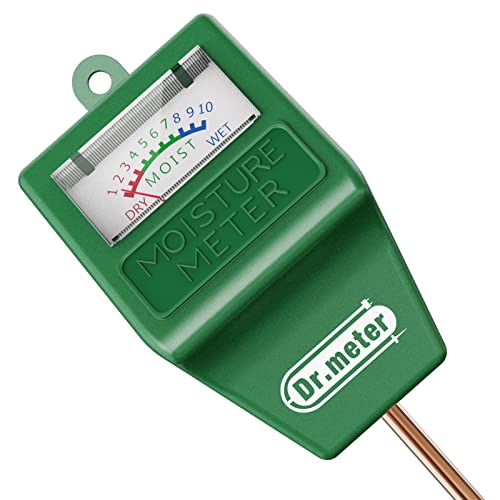
Dr.meter Soil Moisture Meter, Plant Water Meter for Garden Lawn Farm Indoor & Outdoor Use…
Compact & Portable: Have you been sticking your finger in the soil hoping to feel when it's time to water? Why not eliminate the guesswork and keep your hands clean when you use the Dr.meter Soil Moisture Sensor Meter! Know the right time to water your garden, farm, lawn and houseplants, anytime.
What we like
- Moisture only, so the dial is simple to read
- No battery needed
- Maker publishes a plant chart for its 1-10 scale
- 18-month replacement warranty (maker)
Worth noting
- Maker store shows it sold out
- No pH or light readings
- Maker warns against hard or rocky soil
2. Reotemp Garden and Compost Moisture Meter (MM15)
Reotemp calls the MM15 a heavy-duty relative moisture meter for gardeners, composters, farmers and nurseries. The 15-inch stem, 5/16 inch thick, reaches well into a raised bed or a compost pile.
Its trick is calibration. Reotemp’s instructions have you adjust a screw on the back of the dial until it reads 5 in soil or compost at the moisture you want; after that, the guide says, a reading under 5 is too dry and over 5 is too wet. That makes the dial a comparison against your own target rather than a fixed number.
Reotemp is also unusually candid about the limits. The probe is sensitive only at the tip, it reads wetness through electrical conductivity (so salts affect it), and it “will not display a percent moisture.” The guide says never to force the stem into compacted or extremely hard soil or through wood chips.
It runs on one AAA battery, included, which Reotemp says typically lasts one season with normal use. The warranty is one year, limited, and excludes units that were altered, abused or improperly used.
For compost, a useful target to calibrate toward: NC State Extension says a pile works best at roughly 40% to 60% moisture and should feel like a wrung-out sponge. The meter won’t show that percentage, but you can set its 5 at a pile that passes the squeeze test. If you’re shopping for a bin to go with it, see our compost tumbler guide.
Reotemp Garden and Compost Moisture Meter (MM15)
A 15-inch, AAA-powered relative moisture meter with a 0-10 dial and a calibration screw, made for soil or compost.
What we like
- 15-inch stem reaches deep beds and compost
- Calibrates to your own soil or pile
- Readable maker manual and 1-year limited warranty
Worth noting
- Needs a AAA battery
- Reads only at the tip, and salts affect it (maker)
- No pH or light readings
3. iPower 3-in-1 Soil Test Kit
The iPower is a single-probe 3-in-1 meter: you switch it between moisture, pH and light modes and read the same dial. We couldn’t read an iPower product page or manual, so everything here comes from the Amazon listing.
The listing gives a moisture scale of 1-10 (1-3 dry, 4-7 normal, 8-10 wet), a pH range of 3.5-8 and a light range of 0-2000 lux, and says no battery is needed. It also says to avoid excessively hard or loose soil, keep the probe clean and dry, and not to test liquids.
The listing calls the readings accurate. We don’t repeat that, because iPower publishes nothing we could check it against, and the extension research above says pH probes of this type do poorly.
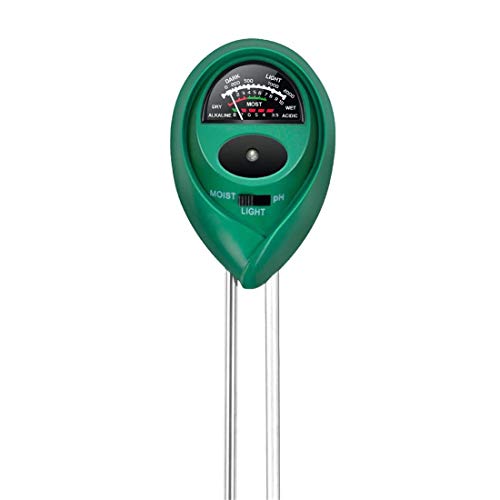
iPower 3-in-1 Soil Test Kit, Soil Moisture/Light/pH Meter for House Plant, Garden, Lawn…
3 in 1 Soil Moisture Meter+ Soil pH Meter+Sunlight Meter: This meter can test soil moisture, light and pH value by switch modes with one button; It makes gardening and planting more efficient.
What we like
- Moisture, pH and light modes on one probe
- No battery needed (listing)
- Listing explains what each moisture band means
Worth noting
- No maker page or manual we could read
- pH mode is the weak point of probes like this
- No warranty found
4. Vivosun 3-in-1 Soil Tester
Vivosun sells a near twin of the other 3-in-1 meters here, but it’s the one with a maker page we could actually read. Vivosun lists it as model 305131J, a single probe that switches between moisture, light and pH with one button.
The maker gives a moisture range of 1-10 (dry to moist), light of 0-2000 (low light to strong light, with no unit) and pH of 3.5-8. It says no battery is needed, that the meter is designed for testing soil only, and that it shouldn’t be used in pure water or other liquids.
Vivosun’s pages disagree on the warranty term, so we don’t print one. The maker makes no accuracy claim, and the pH caution above applies here too.
Vivosun 3-in-1 Soil Tester
Single-probe meter with moisture (1-10), light (0-2000) and pH (3.5-8) modes; the maker says no battery and soil only.
What we like
- Maker page lists model, ranges and cautions
- No battery needed
- One-button mode switch
Worth noting
- Light scale has no unit
- Maker pages disagree on the warranty
- pH mode is the weak point of probes like this
5. Jellas 3-in-1 Soil Moisture Meter
The Jellas is another single-probe 3-in-1 meter, sold for moisture, pH and sunlight readings. That’s about all we can tell you with confidence: we found no Jellas website, product page or manual, and the same style of meter is sold under many brand names.
Our old review listed needle lengths, dimensions, a warranty and a “patented” design. We couldn’t confirm any of it, so we’ve removed it.

Jellas Soil pH Meter 3-in-1 Soil Moisture Meter Moisture Sensor Sunlight pH Soil Test…
Jellas Soil pH Meter 3-in-1 Soil Moisture Meter Moisture Sensor Sunlight pH Soil Test Kits for Home and Garden, Indoor/Outdoor Plants - Silver
What we like
- Moisture, pH and sunlight modes on one probe
Worth noting
- No maker page, manual or warranty we could find
- Specs unconfirmed
- pH mode is the weak point of probes like this
6. Sonkir MS02 3-in-1 Soil Tester
The Sonkir MS02 is a 3-in-1 meter for moisture, light and pH. Sonkir’s website didn’t resolve and its store page was gone, so we’re working from the Amazon listing only.
Our old review contradicted itself on whether this meter uses batteries, and we can’t settle it without a maker manual, so we’ve dropped the claim. The listing does say the meter can’t test the pH of liquids, and that if the soil is too dry the indicator won’t move and you should water before testing.

SONKIR Soil pH Meter, MS02 3-in-1 Soil Moisture/Light/pH Tester Gardening Tool Kits for…
Kindly NOTE: This soil tester can not be applied to test pH value of any other liquid. If the soil is too dry the indicator will not move, and water it before testing.
What we like
- Moisture, light and pH modes on one probe
- Listing explains what to do when soil is too dry to read
Worth noting
- No maker page we could read
- Power source and warranty unconfirmed
- pH mode is the weak point of probes like this
Frequently Asked Questions
Are soil moisture meters accurate?
They’re useful guides, not lab instruments. A University of Maryland Extension educator said these meters probably aren’t as accurate as probing the soil with your finger, and makers like Reotemp say their readings are relative and reflect only the soil at the probe tip. Use the meter to compare spots and days, and confirm with your finger.
Are soil pH probe meters accurate?
Not very. A University of Missouri study in the Journal of Extension found soil pH probes gave poor measurements of soil acidity, while hand-held pH meters and color indicator kits did much better. Before you change your soil’s pH, use a proper soil test kit or a university extension lab.
How do you use a soil moisture meter?
Push the probe gently into the root zone, read the dial, then check a second spot. A Maryland Extension educator suggests checking one or two inches below the surface, or about three inches in very large pots. Don’t force the probe into hard soil, and wipe it clean afterward.
What do the numbers on a moisture meter mean?
They’re relative, not a percentage. The iPower listing reads 1-3 as dry, 4-7 as normal and 8-10 as wet; Dr.meter publishes its own plant chart for its 1-10 dial; and Reotemp has you calibrate its dial so that 5 is your target, with lower readings too dry and higher too wet.
Can I leave a soil moisture meter in the soil?
Dr.meter says not to leave its meter in the soil for a long time and to clean the probe after each use. The other makers we could read don’t address it, so the safe habit is to pull the meter out and wipe it after every reading.
Does a moisture meter work in compost or potting mix?
Reotemp makes its long-stem meter for soil or compost and has you calibrate it to the material. NC State Extension says compost works best at roughly 40% to 60% moisture, about like a wrung-out sponge, but Reotemp’s meter shows a relative 0-10 reading, not a percent. Whatever the medium, Reotemp and Dr.meter both warn against forcing the probe through hard or dense material.
Conclusion
A soil moisture meter is a quick check on watering, and that’s the job to buy one for. For houseplants, the moisture-only Dr.meter keeps things simple if you can find it in stock. For beds and compost, the Reotemp’s long stem and calibration screw make it the best-equipped meter here for those jobs.
The 3-in-1 meters from iPower, Vivosun, Jellas and Sonkir add pH and light modes, but treat those as rough at best. When you need a real pH number, test the soil properly. And if you’re starting seedlings indoors, our mini greenhouse guide is a good next stop.