Best Shade Sails: Triangle Sails, Kits and Hardware
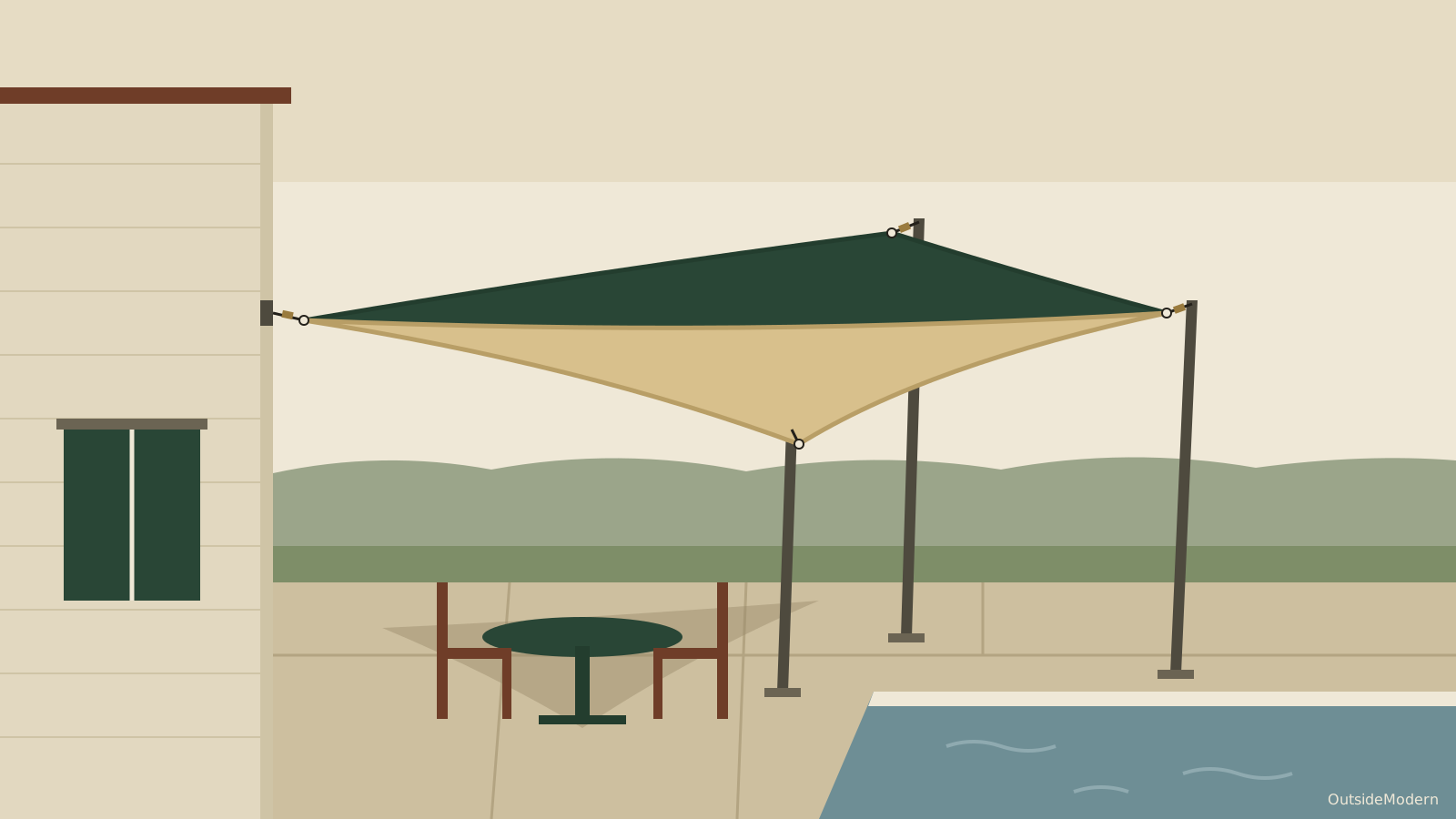
Sun shade sails can bring great beauty to a patio, deck, or pool area. They create a pleasant oasis with a different ambiance than umbrellas or other shade devices can. Reminiscent of a bird in flight, they billow softly in the breeze, making a sweeping, dramatic design accent.
The best shade sails are also quite useful. They can shade a pool that otherwise could not be covered, or a patio with no central pole in the way. If you’re still deciding between a sail and other kinds of shade, our guide to shading a patio compares sails, umbrellas, awnings, pergolas and gazebos.
What’s changed in this update: we rebuilt the picks around makers that publish their own mounting and take-down instructions, took specs and warranties from the makers’ pages and manuals, gathered the hardware into one section, and added a buying guide on breathable vs waterproof fabric. Several older picks are no longer sold or can’t be traced to a maker; they’re listed at the end.
Complete Triangle Kit From the Maker
Our top pick is the Coolaroo Premium Shade Sail Kit, 16 ft 5 in Equilateral Triangle. It pairs a 350 gsm knitted HDPE sail with stainless corner rings and the fixing hardware, and Coolaroo’s US manual walks you through posts, footings and tensioning.
Rope-Tied Sail for Seasonal Shade
Our budget pick is the Coolaroo Ready-To-Hang Shade Sail, 16 ft 5 in Equilateral Triangle. It’s a lighter 165 gsm sail with three 20 ft ropes already attached, made to go up for the season and come down before storms.
Best Shade Sails at a Glance
| Pick | Shape and size | Fabric | Water | Comes with | Warranty (maker’s words, shortened) |
|---|---|---|---|---|---|
| Coolaroo Premium Shade Sail Kit (best overall) | Equilateral triangle, 16 ft 5 in | 350 gsm knitted HDPE | “Breathable” (Coolaroo) | Stainless corner rings; 2 turnbuckles and 3 pad eyes among the fixing accessories (Coolaroo manual) | 15-year limited fabric warranty against UV-caused cracks, splits and tears; pro-rated; fading excluded |
| Windscreen4less 180 GSM Curved Triangle (custom sizes) | Curved-edge equilateral triangle, 16 x 16 x 16 ft | 180 GSM knitted HDPE | Sold as “permeable” (Windscreen4less) | Steel D-rings at the corners; no hardware stated | 3-year warranty listed; limited warranty excludes wind damage, storms and UV fading |
| Coolaroo Ready-To-Hang Shade Sail (budget pick) | Equilateral triangle, 16 ft 5 in | 165 gsm knitted HDPE | “Breathable” (Coolaroo) | Three pre-attached 20 ft ropes (Coolaroo manual) | 3-year limited fabric warranty against UV-caused cracks, splits and tears |
Specs and warranty terms are each maker’s own. We don’t compare UV figures between makers.
Shade Sails – What To Look For
A shade sail looks simple, but it’s a tensioned structure, and a few choices decide whether it hangs tight for years or flaps itself to pieces. The big ones are where you anchor it, the fabric, the shape and size, and the hardware.
Patio Environment and Anchor Points
The most important part of a shade sail design is a careful look at the space around it. Every corner needs a solid mounting point, and getting one may take some work.
Those corners pull hard. Coolaroo’s Everyday and Commercial Grade assembly guide warns that “Your sail will be under significant tension” and that fixing points “need to be strong.” Anchor to posts set in concrete, or into the structural framing or masonry of the house, as your sail maker’s instructions describe. Coolaroo’s US manual says to get advice from a builder or engineer if you’re unsure about a fixing point, and its Australian guide also points you to a qualified builder or engineer.
A few places are off the list. Never a gutter: Coolaroo’s US blog names “thin fences or gutters” as weak structures to avoid. A fascia board only with a fascia support bracket that carries the load into the rafters; Coolaroo’s US manual says a fascia support is “strongly recommended” if you fix to a fascia. And trees: Coolaroo’s Everyday and Commercial Grade guide says a tree is not recommended for a sail fixing, while its US manual allows a tree for temporary use only, with a trunk at least 9.75 in across.
For the full walk-through, from choosing anchor points to tensioning, see our shade sail installation guide.
Posts and Footings
If you need posts, follow your own sail maker’s instructions. As an example, here is what Coolaroo’s US manual (the Premium triangle kit and Coolhaven editions) calls for with its sails:
- Steel posts: minimum 4 in diameter round or 4 x 4 in square galvanized steel, at least 1/8 in thick, leaned at least 10 degrees away from the center of the sail.
- Timber posts: minimum 5 in diameter treated timber, leaned at least 20 degrees away from the center.
- Footings: 15.5 x 15.5 in square and 31 in deep when the sail’s sides are under 13 ft, or 47 in deep when they’re over 13 ft.
- Concrete: Coolaroo doesn’t recommend rapid-set concrete and says to let posts set for at least 48 hours.
Coolaroo’s US blog gives a shorter rule of thumb (“at least 2 feet deep”), so even one maker’s documents differ. The manual for the sail you actually buy is the one to follow, and a large or high-load sail is a job for a pro or an engineer where the maker says so.
Before you dig, call 811 (or use your state’s 811 online request) a few business days before you dig post holes; it’s free. Start at call811.com. Coolaroo’s manual also says to plan around electrical and telephone cables and water and sprinkler pipes.
Breathable vs Waterproof Fabric
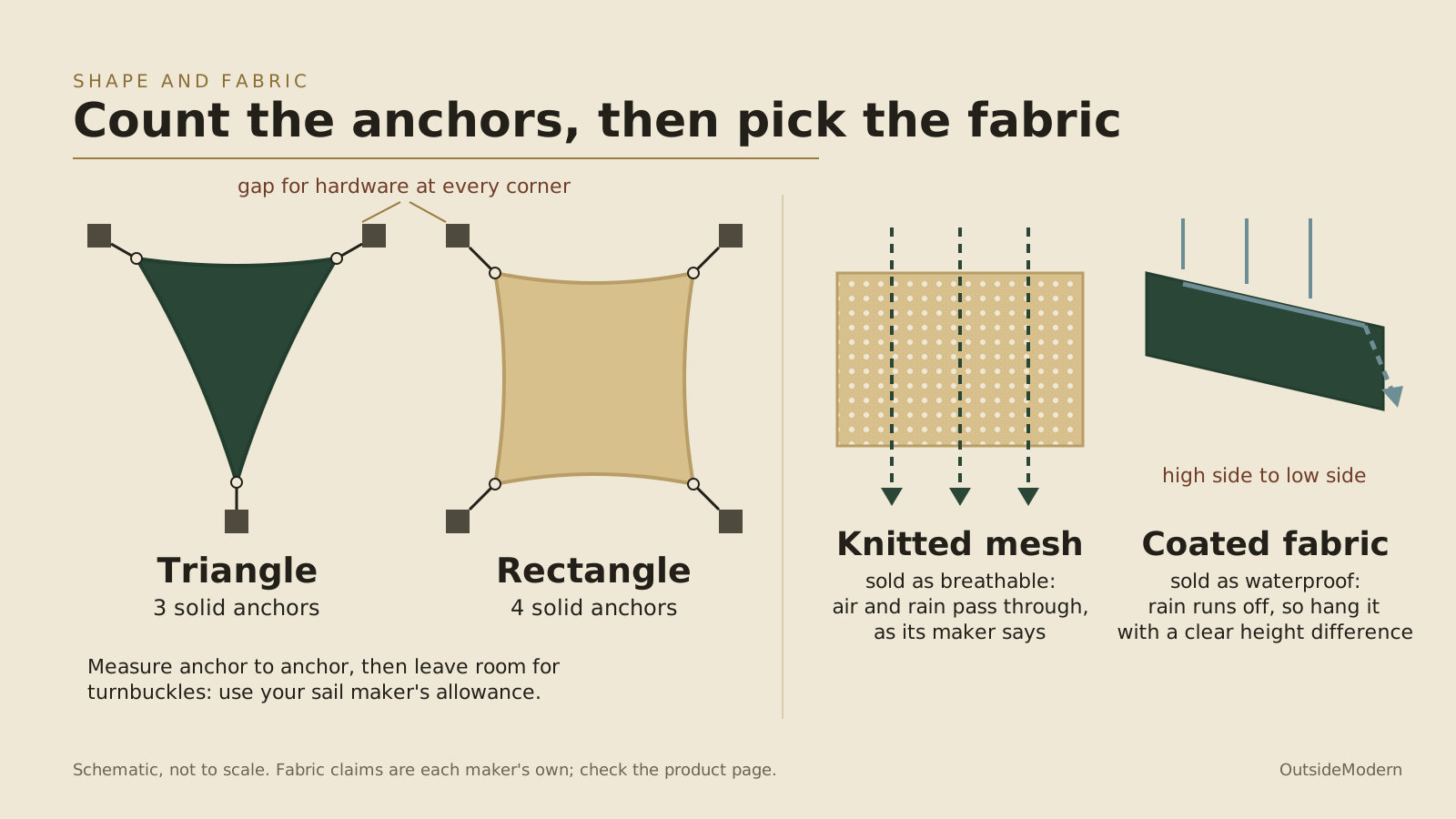
Most shade sails, including all three picks below, are knitted HDPE (high-density polyethylene). Coolaroo calls its fabric breathable: “Air flows freely through our unique fabric construction.” Windscreen4less sells its 180 GSM HDPE sails as permeable, in a category it calls “Permeable Shade Sails.” Neither maker calls these sails waterproof, so don’t count on them to keep you dry.
Waterproof sails are a different fabric. Alion Home explains that “Waterproof PU-coated polyester is a solid fabric” and that it “should be installed with sufficient slope and tension so rainwater can drain instead of collecting in low spots.” Shade&Beyond says a height difference between the sides is essential “especially in waterproof sails.” Ponding isn’t a small thing: Coolaroo’s Everyday and Commercial Grade guide warns that water left to pond “will lead to premature sail failure and may lead to structural failure at fixing points.”
We don’t have a waterproof pick this time. None of the waterproof sails we checked had all three of the things we look for: the maker’s own mounting or take-down instructions, a maker slope instruction for that sail, and a maker page showing it in stock. Windscreen4less, for one, sells a polyester line it calls waterproof, but we found no slope guidance from Windscreen4less for it.
Shape
There are two common shapes: triangles and rectangles (including squares). A triangle needs three solid anchor points; a rectangle needs four, and that fourth point is often the hard one. If one side of the sail runs along the house, a rectangle still needs two corners out in the yard, which many people don’t have a handy spot for.
Whatever the shape, set the corners at different heights. Coolaroo’s US blog says alternating high and low corners “is called hypar” and brings benefits such as “longer wear against the elements.” Coolaroo’s Everyday and Commercial Grade guide describes the four-corner version as two high corners and two low, and a triangle as two high and one low.
Size and Hardware Allowance
The size of a shade sail must be in proportion to the area it covers, and the sail is always smaller than the space between your anchors. You need room at each corner for the turnbuckle or other tensioning hardware. Coolaroo’s installation guides allow 10% of the sail length between each corner and its fixing point; Coolaroo’s US blog says 10 to 12 inches. Use your own sail maker’s allowance.
Curved-edge sails also run a little short. Windscreen4less says its curved sides may deviate 1 to 6 inches in side length and that its sails “will be 4-6 inches shorter in middle width.”
Wind, Snow and Taking It Down
None of the sail makers we read publishes a wind speed rating for its sails, so we don’t print one. What they do publish is advice to take the sail down:
- Coolaroo’s Premium manual: “Temporarily remove” the sail “during storms and periods of strong winds.”
- Coolaroo’s US blog: “loosen or remove sails in heavy snow or extreme wind.”
- Windscreen4less: “If strong winds or severe weather is forecasted, removal of the shade sail and/or fence screen is recommended.”
Plan for it. A sail you can unclip from its hardware in a few minutes is a sail you’ll actually take down when a storm is coming.
Permits, 811 and Fire
Check with your local building department and HOA before you build or attach. Coolaroo’s Everyday and Commercial Grade guide also says to check building regulations with your local authorities before installing.
Keep grills, fire pits and patio heaters out from under a sail, awning, gazebo or pergola canopy unless its maker allows it, with the maker’s clearances. No sail maker on this page allows it; Coolaroo’s US manual says “Do not use your barbecue, grill or fire pit under the shade structure.” For grill placement in general, the U.S. Fire Administration says to place your grill “well away from siding and deck railings and out from under eaves and overhanging branches.”
Sun Protection
Shade helps protect your skin from too much sun, but it’s one layer, not the whole plan. The CDC lists staying in the shade among several ways to protect your skin and notes that UV rays reflect off surfaces like water, cement and sand. Coolaroo’s Australian guide says shade “should not be used as the sole source of sun protection.” Where a maker lists a UV figure for a sail below, we quote it for that sail only.
Color and Layering
Consider the color options when shopping for a sail. The color sets the mood of the patio, and if you’re hanging more than one sail, overlapping different colors at different heights creates a dramatic effect.
Shade Sail Reviews
Below are our three picks, each with its maker’s own guidance on mounting and taking it down. Hardware kits get their own section after the reviews.
1. Coolaroo Premium Shade Sail Kit, 16 ft 5 in Equilateral Triangle
The Premium kit is the most complete package on this page. You get a heavy 350 gsm knitted HDPE sail with reinforced edges and stainless steel rings at the corners, plus the fixing accessories to hang it. Coolaroo’s manual says the kit “includes the fixing accessories needed for installation,” among them two turnbuckles and three pad eyes.
It’s also the best-documented sail we found. Coolaroo’s US manual covers post sizes, post lean, footing size and depth, the corner gap and how tight to go: stop “when the shade sail is rigid with little or no creases and does not sag.” It says to use the two turnbuckles on two of the corners and to keep fire and open flames away from the fabric. And it’s clear about weather: temporarily remove the sail “during storms and periods of strong winds.”
Coolaroo lists up to 95% UV block for this sail and calls the fabric breathable. Coolaroo doesn’t call it waterproof, so don’t count on it to keep rain off, and set the corners at different heights; Coolaroo’s US blog warns against installing a sail completely flat because of the “risk of water pooling.”
The warranty is a real one, in Coolaroo’s words: a 15-year limited warranty if the product “cracks, splits or other tears” as a direct result of UV exposure. It’s pro-rated, it excludes discoloration from long sun exposure, damage from a nearby open flame and over-tensioning, and it needs your original receipt and a fabric sample.
The drawback is the work. This is a permanent install, and if you need posts, Coolaroo’s footings run 31 to 47 inches deep depending on the sail’s side length. Coolaroo itself says most Premium buyers “opt for professional installation.” Only two of the three corners get a turnbuckle, too.
Buy it from Coolaroo: Premium Shade Sail Kit, 16 ft 5 in Equilateral Triangle.
2. Windscreen4less 180 GSM Curved Triangle Sun Shade Sail, 16 x 16 x 16 ft
Windscreen4less has been on this list since the beginning, and the reason hasn’t changed: choice. Besides stock sizes like this 16 ft triangle, it makes custom-size curved-edge triangles from 2 ft up to 28 x 28 x 40 ft, so you can get the cut you need for an odd-shaped space. Its custom-size page lists colors including beige, light gray, brown, turquoise green, dark green, blue, red and orange. The box below is the blue version; the same sail also comes in sand.
The fabric is 180 GSM knitted HDPE, which Windscreen4less sells as permeable. Windscreen4less doesn’t call this line waterproof, so don’t count on it to keep the rain off. Each corner has a steel D-ring.
Windscreen4less puts its installation warnings on its shipping and returns page. It says to “Ensure all mounting points are structurally sound and all hardware is secured tightly,” to keep the sail away from electrical wires and open flames, and to periodically check the anchors. On weather it’s direct: “If strong winds or severe weather is forecasted, removal of the shade sail and/or fence screen is recommended.” It also says proper anchoring and removal are the buyer’s responsibility.
If you want to build a layered, multi-sail display, Windscreen4less may be your best bet, since you can mix sizes and colors in the same fabric.
The drawbacks: we found no hardware listed as included, so budget for a kit (see below). Windscreen4less publishes no post, footing or slope figures, so you’ll be leaning on other makers’ guidance and our installation guide. And read the warranty. Windscreen4less lists a 3-year warranty; its limited warranty covers manufacturing defects and excludes “Damage caused by high winds, including gusts of 40 mph or greater, regardless of duration,” plus storms, UV fading and improper installation. Custom sizes are made to order and, per Windscreen4less, “cannot be resold,” so measure carefully.

Windscreen4less 16' x 16' x 16' Sun Shade Sail Triangle Outdoor Canopy Cover UV Block for…
High quality material: Our sun shade sail is made of 180 GSM high density polyethylene fabric with strong stitched seam and double webbings, durable and solid. With D-rings in each corner, it can be easily attached to any point to provide shade for you.
What we like
- Many stock and custom sizes, including curved triangles up to 28 x 28 x 40 ft
- Wide color range
- Sold as permeable HDPE (Windscreen4less)
- Steel D-rings at each corner
- Maker says to take it down before strong winds
Worth noting
- No hardware stated as included
- No post, footing or slope figures from the maker
- Warranty excludes wind damage, storms and UV fading
- Custom sizes can't be returned for resale
3. Coolaroo Ready-To-Hang Shade Sail, 16 ft 5 in Equilateral Triangle
The Ready-To-Hang sail is the easy option. It arrives with three 20 ft ropes already tied to the corners, per Coolaroo’s manual, so you can tie it off and have shade the same afternoon. Coolaroo calls it semi-permanent and says no special tools or hardware knowledge are required.
It’s made to come down, and Coolaroo says so. The manual says to “take down your shade sail when not in use or before strong storms,” and the product FAQ recommends taking it down “during severe weather events or during off-seasons in harsh climates.” The manual also asks for attachment points that can “withstand occasional windy conditions,” and says to pull the ropes tight so the sail doesn’t sag and to check the tension now and then.
The fabric is a lighter 165 gsm knitted HDPE that Coolaroo calls breathable. Coolaroo’s product page gives several different UV figures for this sail, so we don’t print one. The warranty, in Coolaroo’s words, is a 3-year limited warranty against cracks, splits and tears caused by UV exposure, with the same exclusions as the Premium (fading, flame, over-tensioning).
The drawbacks: rope tie-offs make it hard to get a sail drum-tight, the fabric is lighter than the Premium’s 350 gsm, and the warranty is 3 years instead of 15. If you want a tighter hang, Coolaroo sells turnbuckles and pad eyes separately; see the hardware section below.
Buy it from Coolaroo: Ready-To-Hang Shade Sail, 16 ft 5 in Equilateral Triangle.
Shade Sail Hardware Kits
A sail without hardware needs, at minimum, something to anchor each corner (a pad eye or eye bolt) and something to tension it (a turnbuckle). Coolaroo’s installation guides call for at least two turnbuckles per sail. Coolaroo’s US manual also says to make sure “all accessories face towards the middle of the shade sail and are tightly secured.”
Coolaroo hardware. Coolaroo sells the stainless steel fittings its own sails use. The Professional Shade Sail Hardware Kit, Triangle includes, in Coolaroo’s words, “(6) x 8mm D-Shackles, (3) x Pad Eyes, and (3) x 8mm Jaw/Jaw Turnbuckles.” Coolaroo also sells parts singly, including the 8 mm Hook and Hook Turnbuckle, which it says is “used to adjust wire tension or length,” and a stainless steel Pad Eye, “typically mounted on a post or building facade.” Its 8 x 50 mm triangle ring, used to bridge the gap between a mounting point and a sail, was out of stock at Coolaroo when we checked. Coolaroo publishes no steel grade or load rating for these parts, so we don’t print one.
COSCOOL kits. Generic stainless kits like COSCOOL’s 6 in triangle and rectangle kits bundle turnbuckles, pad eyes, hooks, screws and expansion anchors (the triangle kit’s listing says 2 turnbuckles, 3 pad eyes and 1 hook; the rectangle kit’s says 2 turnbuckles, 4 pad eyes and 2 hooks). We used to recommend them. We couldn’t find a COSCOOL maker site or a readable COSCOOL mounting manual, so we no longer box them. If you use a kit like this, follow your sail maker’s mounting instructions and make sure each anchor goes into something structural.
Whatever kit you buy, the screws and anchors are only as good as what they go into. Posts in concrete, framing or masonry, per your sail maker; never gutters. Our installation guide covers placing and tensioning each corner.
Previously Recommended
- Apontus Sun Shade Sail Rectangle, 18 x 18 ft, sand: we can no longer find it for sale. For a square sail, consider the Coolaroo Premium line’s 17 ft 9 in square.
- New ProSource 16 ft Sun Shade Sail, sand: we can no longer find a maker page for it. We now recommend the Coolaroo Ready-To-Hang instead.
- A square 18 x 18 ft tan sail sold under the generic name “Shade Sails”: we can no longer identify its maker. For a square sail, consider the Coolaroo Premium 17 ft 9 in square.
Frequently Asked Questions
Are shade sails waterproof?
Many aren’t. Knitted HDPE sails like all three of our picks are sold as breathable (Coolaroo’s word) or permeable (Windscreen4less’s), and none of their makers calls them waterproof. Sails sold as waterproof use a solid fabric, such as the PU-coated polyester Alion Home describes, and makers say they need enough slope and tension for rain to drain off.
What size shade sail do I need?
Measure the space between your anchor points, then subtract room for hardware at each corner. Coolaroo’s installation guides allow 10% of the sail length at each corner (its US blog says 10 to 12 inches), so the sail is always smaller than the space. Follow your own sail maker’s allowance.
Should you take a shade sail down in wind or snow?
Yes, when the makers say so. Coolaroo’s Premium manual says to temporarily remove the sail during storms and strong winds, and its US blog says to loosen or remove sails in heavy snow or extreme wind. Windscreen4less recommends removing its sails if strong winds or severe weather are forecast.
Is a triangle or rectangle shade sail better?
A triangle needs only three anchor points, which is easier to find in most yards, and it’s simple to twist with one low corner for runoff. A rectangle needs four solid anchors, and the fourth is often the hard one to find. Choose by the anchor points you have.
What hardware do you need to hang a shade sail?
An anchor at each corner (a pad eye or eye bolt) and tensioners, usually turnbuckles. Coolaroo’s guides call for at least two turnbuckles per sail. Coolaroo’s Premium kit includes the fixing accessories, and Coolaroo sells a triangle hardware kit for sails that come without them.
Can you put a grill or fire pit under a shade sail?
No. Keep grills, fire pits and patio heaters out from under a sail unless its maker allows it, with the maker’s clearances, and no sail maker on this page does. Coolaroo’s US manual says not to use a barbecue, grill or fire pit under the shade structure.
Conclusion: The Best Sun Shade Sail
All three sails here will give you good shade; the right one depends on how permanent you want it to be.
For a sail that stays up all season, the Coolaroo Premium Shade Sail Kit is our pick: heavy fabric, hardware in the box, a 15-year limited fabric warranty and a maker manual that covers posts and footings. If your space needs an unusual size or you want to layer colors, the Windscreen4less curved triangle comes in more sizes and colors than our other picks. And for seasonal shade you can take down before a storm, the Coolaroo Ready-To-Hang goes up with three ropes and no tools.
Before you buy, plan your anchor points; the installation guide linked above walks through it. If you’re covering a pergola rather than hanging a free sail, see how to cover a pergola for shade. For other ways to shade a patio, see our best patio umbrellas, best window awnings and our guide to growing shade with trees and vines.