Outdoor Cushion Buying Guide: Fabric, Fill and Fit
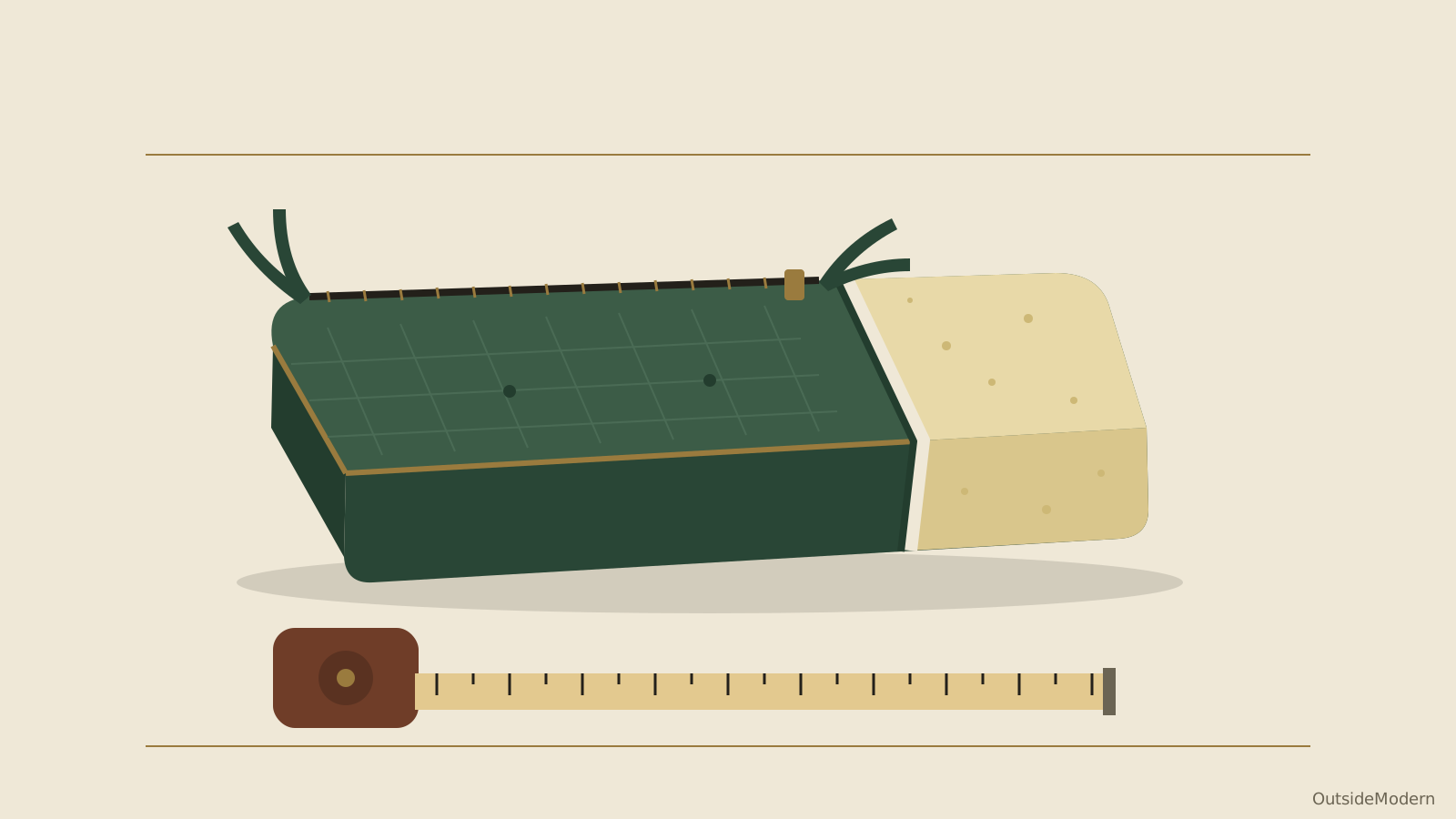
New cushions are the quickest way to make tired patio furniture feel new again. They’re also easy to get wrong. A cushion that’s an inch too narrow slides around, a cover that fades in one summer looks shabby by August, and a foam core that holds water stays soggy for days.
This guide covers the four things that decide whether a cushion works outside: fit, cover fabric, fill and care. It’s part of our guide to outdoor furniture materials and care, which covers the frames those cushions sit on.
What’s changed in this update: we rewrote the fabric section from the fabric makers’ own wording, corrected several fill and fabric claims, added how to measure, and rebuilt the cleaning and storage advice around the makers’ care instructions.
Fit: Cushion Types and Sizing
Fit comes first. A beautiful cushion that doesn’t match your seat is a cushion you’ll be fighting every time you sit down.
Most outdoor cushions fall into a few types:
- Seat cushions for dining and side chairs, often sold in fixed sizes or made to order.
- Deep seating cushions (a seat and a back) for sofas, loveseats and lounge chairs.
- Chaise cushions, one long piece for a chaise lounge.
- Adirondack cushions, shaped for the slanted seat and tall back of an Adirondack chair. We cover these in our Adirondack chair cushions guide.
- Throw and lumbar pillows, which add color more than support. See our Sunbrella lumbar pillows roundup.
If you’re shopping for a new set rather than new cushions, our roundup of patio sets with Sunbrella cushions is a good place to start.
How to Measure for Outdoor Cushions
Grab a tape measure and measure the furniture, not the old cushion, since an old cushion may have lost its shape. The Company Store, a cushion seller, gives the basics:
- Width: “Measure the widest part of the seat from side to side.”
- Depth: measure the seat “front to back at its deepest point.”
- Back: for lounge and deep seating cushions, repeat both measurements for the backrest.
For a seat and back that are joined in one piece, custom cushion maker Cushion Source says to subtract the seat cushion’s thickness from the back height, and to round to the nearest 1/4 inch.
Write the numbers down before you shop, and check them against the cushion maker’s size chart rather than the product photo. Be sure to measure every chair if your set is mixed!
Custom vs Off-the-Shelf Cushions
Off-the-shelf cushions come in fixed sizes and are the quickest route when your furniture has standard proportions. Custom cushions are made to your measurements or to a specific chair, which matters for unusual shapes and older sets.
A custom option: WholesaleTeak Dining Chair Seat Cushion. Teak furniture seller WholesaleTeak lists a Dining Chair Seat Cushion (SKU DCCS) on its own store, described as “Custom – Same as Seat,” so it’s made to the seat size of WholesaleTeak’s own dining chairs. The cushion page offers a swatch picker of the fabric lines WholesaleTeak lists as Sunbrella fabrics, including Canvas, Cast and Spectrum solids plus stripes and textures. It’s best for owners of WholesaleTeak dining chairs who want a matched fit. The drawback: on the maker pages we could read, WholesaleTeak doesn’t publish the fill, warranty or care details, so ask before you order.

WholesaleTeak Dining Chair Outdoor Fabric Outdoor Seat Cushion (Dining Chair not…
The Seat Cushion Made out of Outdoor fabric which is the best for outdoor living.
What we like
- Made to the seat size of WholesaleTeak dining chairs
- Choice of Sunbrella fabric lines
- Listed on the maker's own store
Worth noting
- Fill not stated on the maker pages we read
- No warranty or care details published by the maker
- Sized for WholesaleTeak's own chairs
An off-the-shelf example: Classic Accessories Montlake chaise cushion. Montlake is a fixed-size chaise cushion that Target still lists; its listing gives the cover as “93% Polyester, 7% Cotton” in what Classic Accessories calls FadeSafe solution-dyed fabric. Classic Accessories no longer lists Montlake cushions on its own site, so check stock before you plan around one. It’s also a good reminder to read the fine print: Classic Accessories says in its own replies to shoppers that “the water resistant fabric is not waterproof,” and it advises against machine washing.
Outdoor Cushion Fabrics
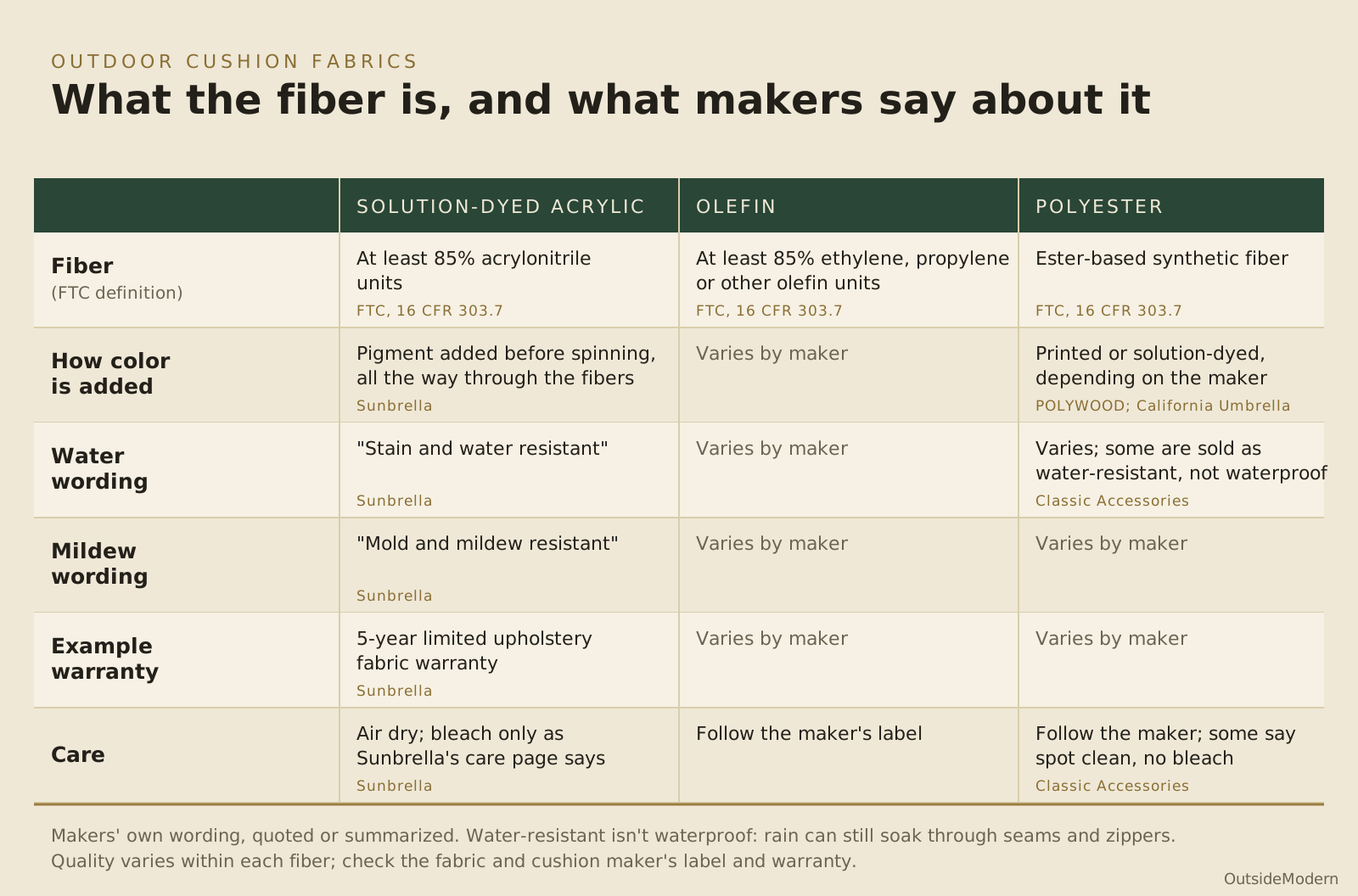
The cover fabric decides how a cushion handles sun, rain, spills and mildew. Under FTC fiber rules, acrylic, olefin and polyester are three different fibers, so a label that names the fiber tells you a lot. For a deeper dive, see our guide to types of outdoor fabric.
Solution-Dyed Acrylic (Sunbrella, Outdura)
Solution-dyed acrylic is the premium choice. “Solution-dyed” means the color goes into the fiber before it’s spun, rather than being printed on top.
Sunbrella, the best-known brand, describes its fabric as “100% solution-dyed acrylic” that is “stain and water resistant,” “mold and mildew resistant” and “inherently fade resistant.” Sunbrella upholstery fabrics carry a 5-year limited warranty. Note that it covers the fabric, not the cushion’s fill or seams, and claims go through the seller. Outdura is also a solution-dyed acrylic, according to its maker Sattler.
Sunbrella says its fabric is fade resistant, not fade-proof. Any fabric left in strong sun long enough will eventually change. Solution-dyed acrylic is the premium tier, and in our opinion it’s usually worth it on cushions you’ll use every day.
Olefin
Olefin is a different fiber from acrylic, despite what you’ll sometimes read. Makers describe it well:
- Revolution Fabrics, a fabric seller, says olefin “dries quickly when wet.”
- California Umbrella credits olefin with “improved fade resistance” over polyester and cotton (that’s umbrella fabric, but the comparison carries over).
- POLYWOOD, a furniture maker, writes that “olefin is ideal for cushion covers and fillers.”
As with any fabric, check what the specific maker claims for mildew and fading rather than assuming.
Polyester
Polyester covers a wide range. POLYWOOD notes that some polyester is spun first and then dyed, and that patterns are often screen-printed onto blank fabric. Other polyester is solution-dyed, such as California Umbrella’s Pacifica fabric.
Expect polyester to rate a step below solution-dyed acrylic for fade resistance. California Umbrella, which sells both, rates its Pacifica polyester “Great Fade Resistant” and its Sunbrella “Excellent Fade Resistant.”
Vinyl-Coated Polyester Mesh
Vinyl-coated polyester is mostly a sling-chair fabric, but it shows up on cushions too. POLYWOOD describes vinyl fabric as made by coating polyester fibers with liquid vinyl. Phifer, which makes Phifertex, says its fabrics are woven from “PVC-coated polyester yarns,” dry “lightning fast,” and use Microban to inhibit mold and mildew. Phifer lists a three-year warranty and sells a Phifertex cushion collection.
Cotton Canvas
Plain cotton canvas isn’t a great outdoor cushion fabric. POLYWOOD says it is “susceptible to mildew and mold” unless it’s sprayed with a fabric protectant.
Water-Resistant vs Waterproof
Water-resistant fabric sheds light rain, but water can still soak through seams, zippers and a long downpour, so it isn’t waterproof. Makers like Sunbrella and Classic Accessories call their cushion fabric water-resistant, not waterproof.
The Company Store’s advice for its own Sunbrella cushions says it plainly: “Though water resistant, for best results stow away Sunbrella® cushions when it rains.” We’d skip any cushion whose listing promises “waterproof” or “weatherproof” without the maker backing it up.
Fabric Comparison at a Glance
| Solution-dyed acrylic | Olefin | Polyester | |
|---|---|---|---|
| Fiber (FTC) | at least 85% acrylonitrile units | at least 85% ethylene, propylene or other olefin units | ester-based synthetic fiber |
| How color is added | pigment added before spinning (Sunbrella) | varies by maker | printed or solution-dyed (POLYWOOD; California Umbrella) |
| Water wording | “stain and water resistant” (Sunbrella) | varies by maker | varies by maker; “Water-Resistant” (Classic Accessories Montlake, retailer page) |
| Mildew wording | “mold and mildew resistant” (Sunbrella) | varies by maker | varies by maker |
| Fade wording | “fade resistant” (Sunbrella) | improved over polyester and cotton (California Umbrella) | “Great Fade Resistant,” a tier below its Sunbrella (California Umbrella) |
| Example warranty | 5-year limited upholstery fabric warranty (Sunbrella) | varies by maker | varies by maker |
| Care | follow Sunbrella’s care page | follow the maker | follow the maker (Classic Accessories: no bleach) |
Cushion Fill
The fill decides how a cushion feels and how fast it dries. Cushion makers and foam sellers describe the main types differently, so here’s who says what.
Polyester Fiber Fill
Polyester fiber fill is fluffy, loose fiber rather than foam. Cushion Source calls it “non-absorbent and mildew resistant” and says water “will flow right through the cushion and drain and dry quickly.”
Standard Foam
Foam holds its shape better. Cushion Source gives foam a higher rating for comfort and shape retention than fiber fill, but foam drains slowly, and Cushion Source recommends standard foam for indoor use, with an exception for cushions under 4 inches thick in protected outdoor spots. If a foam cushion gets soaked, it suggests unzipping the cover and standing the cushion on its side to dry.
Many deep seating cushions combine the two. The Company Store, for example, uses a “high density foam core wrapped in thick densified polyester.”
Quick-Dry (Reticulated) Foam
Quick-dry foam is made for wet spots. Foam N’ More, a foam seller, describes its drain-dry foam as an open-cell outdoor foam whose “large, open pores permit maximum water drainage and air circulation,” with a fungicidal additive in that product. It also warns that the foam “is not UV-sun resistant,” so keep it inside a cover. Not every open-cell foam drains like this, so look for the maker to say “quick-dry,” “dry fast” or “reticulated.”
Thickness is a matter of taste. A thicker cushion can feel plusher, but the fill type and how firm it is matter at least as much. If comfort is your top priority, see our guide to the most comfortable outdoor furniture.
Construction Details
A few small details make a cushion much easier to live with:
- Removable covers. A zippered cover can come off for cleaning. Sunbrella says to close all zippers before machine washing and to “consult the furniture manufacturer before removing the casing.”
- Ties. Ties on the back of a cushion keep it from sliding off the seat or blowing onto the lawn.
- Drainage. Water has to get out somehow. Yardbird, a furniture maker, suggests propping cushions up after rain “so the water can drain out the bottom.”
Protecting and Caring for Your Cushions
Cleaning
Start with the cushion maker’s care label; it wins over any general advice, including ours. Makers don’t agree. Sunbrella allows machine washing of removable covers, while Classic Accessories advises against machine washing its Montlake cushions and against using soap, bleach or detergent on them.
For Sunbrella fabric, Sunbrella’s upholstery care page says to:
- “Blot (don’t rub) liquid spills.”
- Clean with mild soap and water, then “Rinse the fabric thoroughly to remove all soap residue.”
- Machine wash removable outdoor covers “in cold water on the delicate cycle.”
- Let it air dry. Sunbrella says its fabric “should only be allowed to air dry,” so skip the dryer.
Yardbird says cushions “typically require 1-3 days in the sun to completely dry,” so plan your cleaning for a dry stretch of weather. Test any cleaner on a hidden spot first (University of Georgia Extension).
Mildew
Mildew needs moisture to grow (University of Missouri Extension), so the best defense is a cushion that dries out. For stubborn spots on Sunbrella fabric, Sunbrella gives its own mix: “1 cup of bleach and 1/4 cup mild soap per gallon of water,” and it says to protect the area around the fabric when using bleach. Use bleach only where the fabric and cushion maker allows it.
Never mix bleach with ammonia or any other cleaner (CDC). Work outdoors or with fresh air, and wear gloves and eye protection (CDC), plus whatever the product label adds. Our guide to removing mildew from outdoor furniture covers the full process.
Re-Treating With a Protector Spray
Sunbrella’s care pages say its fabric needs re-treating for water and stain resistance after bleach cleaning or repeated cleanings, and its upholstery care page names its own Sunbrella Restore Fabric Protector & Repellent for re-treating Sunbrella fabric.
303 Fabric Guard is another option; its maker, Gold Eagle, says it’s “Recommended by Sunbrella,” and Sunbrella’s shade-fabric care page names it. Gold Eagle says it doesn’t provide UV protection directly and that the liquid and spray are flammable, so keep it away from heat and flame until it’s dry.
For other outdoor fabrics, 3M’s Scotchgard Outdoor Water Shield is an aerosol water repellent in a 13 oz can (5020-13). Take the label seriously. 3M’s Safety Data Sheet carries the signal word “Danger” and warns, among other hazards: “Extremely flammable aerosol.”, “Pressurized container: may burst if heated.”, “May cause drowsiness or dizziness.” and “May be fatal if swallowed and enters airways.” Keep it out of reach of children. It says to “Use only outdoors or in a well-ventilated area,” “Do not breathe vapor or spray,” and keep it away from heat, sparks and open flames, and it recommends nitrile gloves. It’s a repellent, not a waterproofer. Other brands of aerosol fabric protector have been recalled with CPSC in the past over a respiratory hazard from spray mist, which is one more reason to spray outdoors. Spray a hidden spot first and let it dry before you judge the color.

Scotchgard Outdoor Water Shield…
WATER REPELLENT SPRAY: One Scotchgard Outdoor Water Shield Spray, 13 oz can, that protects fabrics against the elements
What we like
- 3M's dedicated outdoor water repellent
- Aerosol, nothing to mix
- 3M publishes a current Safety Data Sheet
Worth noting
- Extremely flammable aerosol (SDS signal word Danger)
- Use only outdoors or in a well-ventilated area
- Repellent, not waterproof
Storage, Rain and Winter
The single best thing you can do for cushions is bring them in when you’re not using them. Yardbird suggests tucking cushions under furniture covers when they’re not in use, and removing them and storing them indoors when temperatures fall below freezing. Make sure cushions are fully dry before you store them, since mildew needs moisture to grow.
A deck box, a shed or the garage all work. If you leave cushions on the furniture under a cover, choose one that fits: see our guides to patio furniture covers and patio sofa covers. And no one wants to sit on a soggy cushion that’s still drying out from yesterday’s rain!
Frequently Asked Questions
Are outdoor cushions waterproof?
Usually not. Sunbrella calls its fabric “stain and water resistant,” and Classic Accessories says its water-resistant fabric “is not waterproof.” Water can get in through seams and zippers, so bring cushions in or cover them when rain is coming.
What is the best fabric for outdoor cushions?
Solution-dyed acrylic such as Sunbrella is the premium choice: Sunbrella says it is fade, stain, water, mold and mildew resistant, and backs its upholstery fabric with a 5-year limited warranty. Olefin and solution-dyed polyester can also work well. Check what the specific maker claims.
Is olefin better than polyester for outdoor cushions?
Often, for sun. California Umbrella says olefin has improved fade resistance over polyester and cotton, and Revolution Fabrics says olefin dries quickly. Solution-dyed polyester narrows the gap, so compare the maker’s own claims for the exact fabric.
How do you clean outdoor cushions?
Follow the cushion maker’s care label first. For Sunbrella fabric, Sunbrella says to blot spills, clean with mild soap and water, rinse thoroughly and air dry. Test any cleaner on a hidden spot first, and never mix bleach with other cleaners (CDC).
Can outdoor cushions be left outside in the rain or over winter?
They’ll last longer if you don’t. The Company Store recommends stowing Sunbrella cushions when it rains, and Yardbird says to store cushions indoors when temperatures fall below freezing. Dry them fully before storing.
How long do outdoor cushions last?
No maker we read gives a lifespan; it depends on the fabric, fill, sun exposure and how you store them. Warranties are the only firm numbers, such as Sunbrella’s 5-year limited fabric warranty, which covers the fabric rather than the fill or seams.
Conclusion: Buying Outdoor Replacement Cushions
Measure the furniture, not the old cushion. Pick the best cover fabric you can justify, with solution-dyed acrylic at the top. Match the fill to how wet your patio gets, and follow the maker’s care label. Then store your cushions dry and out of the weather, and they’ll stay comfortable for many seasons.
If you bring cushions indoors over winter, our guide to using patio furniture indoors has ideas for putting them to work in the meantime. For frames, finishes and the rest of the care routine, head back to our outdoor furniture materials guide, and if your cushions sit on teak, our guide to sealing teak outdoor furniture covers the wood.
Previously Recommended
- Scotchgard Water & Sun Shield: we couldn’t confirm it’s still sold, so we now point to Scotchgard Outdoor Water Shield.